Zinc Oxide, Gluconate Or Citrate: What A Label With No Form Leaves Out
“Zinc” is the name of an element. A capsule cannot hold the element by itself; it holds a compound of it, and the compound decides how much of the capsule’s weight is zinc and, in some circumstances, how much of that zinc your gut takes in. The Visivra label names Zinc with no salt and no amount. This post reads that one line the way a careful shopper would, using the head-to-head absorption studies for oxide, gluconate and citrate, and says clearly where the evidence stops.
- In one fasted crossover of 15 adults, zinc from citrate (61.3%) and gluconate (60.9%) was absorbed better than zinc from oxide (49.9%), and three people absorbed little or none from the oxide.
- A two-week crossover in 12 men found gluconate gave a modestly higher blood peak (18.3%) and total exposure (8.1%) than oxide. The differences are real and not large.
- Taken inside a phytate-rich meal, zinc oxide and zinc sulfate were absorbed equally in two studies of fortified tortillas. The meal mattered more than the salt.
- Phytate, iron given as a supplement and a large calcium supplement each lowered zinc absorption in human studies, and a 2009 study found dietary calcium did not.
- AREDS named its zinc compound (oxide) and its dose. No trial measured absorbed zinc from the Visivra capsule, and the label gives neither form nor amount.
One word on the label, three questions it cannot answer
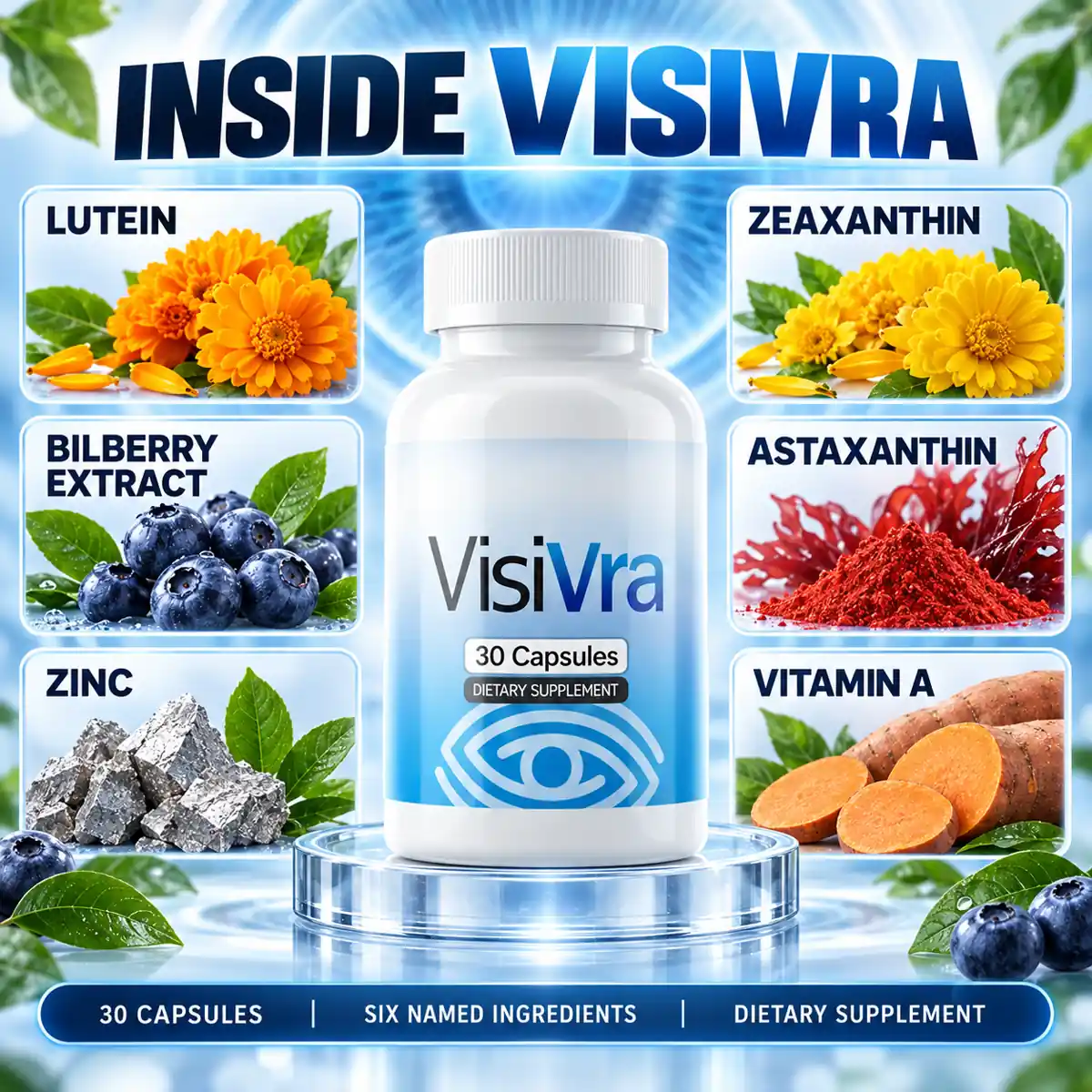
Print “Zinc” on a supplement panel and you have said something true and incomplete. Three follow-up questions decide whether it means much: which compound is it, how much elemental zinc does the capsule deliver, and what will it be taken with. The Visivra front panel and the supplier’s ingredient tile answer none of them. There is no salt named, no milligram figure and no copper beside it. The label and amounts page transcribes the panel, and Six Names, No Milligrams makes the general case that a name without an amount is half a claim. This post is the zinc-specific, form-specific sequel: even if the amount were printed tomorrow, a shopper would still need the form.
Nothing here says what compound Visivra uses. Where a figure appears, it belongs to the study named beside it.
Elemental zinc and compound weight
A supplement made with zinc oxide, gluconate or citrate contains very different fractions of actual zinc by weight, because the rest of the molecule is heavy or light. Arithmetic on the molecular formulas gives roughly four-fifths for zinc oxide, roughly one-seventh for zinc gluconate and roughly a third for zinc citrate. Those are chemistry, not trial results, and exact values depend on the hydrate. The consequence is what matters: “10 mg of zinc gluconate” and “10 mg of zinc” are not the same statement, and a panel that does not say which it means cannot be compared with anything.
The good trials avoid the ambiguity by reporting elemental zinc. The gluconate-against-oxide study below gave 20 mg of metal zinc as gluconate and 17.4 mg of metal zinc as oxide, which is the sort of precision a panel should give and this one does not.
What the head-to-head studies found
Three human studies compare forms directly, and they are all small. It is worth saying that up front, because supplement marketing tends to present a single tracer study as settled fact.
Oxide against gluconate and citrate. A randomized, double-masked, three-way crossover in 15 healthy adults used stable-isotope tracers to measure absorption of 10 mg of zinc given as a supplement, without food, as citrate, gluconate or oxide. Median fractional absorption was 61.3% from citrate and 60.9% from gluconate, which were not different from each other, and 49.9% from oxide, which was significantly lower than both. Three participants absorbed little or none of the oxide. The authors described oxide, which is insoluble in water, as less well absorbed when given as a supplement without food, and possibly minimally absorbed by some individuals.
Gluconate against oxide over two weeks. A crossover in 12 healthy men gave 20 mg of metal zinc as gluconate or 17.4 mg as oxide daily for 14 days each, with a washout between. Peak plasma zinc was 18.3% higher after gluconate and total exposure over 24 hours was 8.1% higher. Both differences reached statistical significance, and neither is large. The authors concluded that absorption could be improved by complexing zinc with gluconate. It is a fair result to hold alongside the first: oxide is behind, but the gap depends on what you measure and how.
Sulfate, gluconate and aspartate with milk. A three-period crossover in eight volunteers gave a small tracer dose of 2.0 mg zinc as sulfate, gluconate or aspartate together with 200 mL of milk. Estimated fractional absorption was highest for the aspartate, and gluconate was higher than sulfate. The authors called it preliminary, which it is. It does not include oxide, but it shows that even among soluble salts the ranking moves with the conditions.
| Study | Forms | Conditions | Headline |
|---|---|---|---|
| 15 adults, crossover | Citrate, gluconate, oxide | 10 mg zinc, supplement, no food | Citrate 61.3%, gluconate 60.9%, oxide 49.9% |
| 12 men, crossover | Gluconate, oxide | 20 mg vs 17.4 mg zinc daily for 14 days | Gluconate peak 18.3% higher, exposure 8.1% higher |
| 8 volunteers, crossover | Sulfate, gluconate, aspartate | 2.0 mg tracer dose with milk | Aspartate highest; gluconate above sulfate |
| 42 women, meal | Oxide, sulfate, plus EDTA forms | Fortified maize tortilla meal, 3.3 mg zinc | Oxide 10.8%, sulfate 10.0%; no difference |
| 10 women, tortilla | Oxide, sulfate | Fortified corn tortilla | Oxide 0.36, sulfate 0.37 fractional absorption |
All figures read from the abstracts of the studies cited in this section and the next. None of them used a Visivra capsule.
Why the meal can matter more than the salt
The comparisons above were done on an empty stomach or with milk. Two studies did the same oxide against sulfate comparison inside a meal, and the answer changed.
In a study of 42 women, zinc was added as oxide, sulfate, oxide plus EDTA or sodium-zinc EDTA to a maize tortilla eaten with beans, chili sauce and milk with coffee. The meal carried 3.3 mg of zinc and had a phytate-to-zinc molar ratio of 17. Fractional absorption was 10.8% from oxide and 10.0% from sulfate, and the groups did not differ significantly; the EDTA versions did no better. A second study in ten women fed corn tortillas fortified with zinc oxide or zinc sulfate and found fractional absorption of 0.36 and 0.37, indistinguishable from each other.
Put the two sets together and a pattern emerges. On an empty stomach the insoluble oxide can lag behind the soluble salts. Inside a food matrix rich in phytate the meal itself is the limiting factor and the form washes out. A label that does not say whether the capsule should be taken with food, and does not name the form, leaves both of those variables open. The Visivra label prints no directions on the face supplied, so this post does not assume any.
What gets in the way of absorption
A review of dietary factors influencing zinc absorption summarizes the human literature. Phytate, found in cereals, corn and rice, has a strong negative effect on zinc absorption from composite meals. Iron can lower zinc absorption when the two are given together in a supplement, but not when the same amounts are in a meal as fortificants. Cadmium inhibits absorption. Protein in a meal helps, casein a little less than other proteins, and amino acids such as histidine and methionine, and organic acids such as citrate, help.
The iron point rests on a classic experiment. In a whole-body counting study, adding iron to zinc in water on an empty stomach at ratios of 1:1 and 2.5:1 did not change zinc absorption, which was 59% and 58%, but at a 25:1 iron-to-zinc ratio it fell to 34%. Given with a meal, the same ratios had no inhibitory effect. Adding histidine to the water solution softened the effect. The authors concluded that a multimineral supplement taken on an empty stomach can be hurt by excessive iron, and that taking it with a meal, or with a zinc ligand, may overcome that.
Phytate has been measured in ordinary diets too. In a study of ten women fed one-day menus of ordinary foods, a high-phytate menu lowered fractional zinc absorption by about ten percentage points and absolute absorption by about a quarter, roughly 1 mg a day, compared with a low-phytate menu. That same study found dietary calcium did not impair zinc absorption at either phytate level.
Calcium is where the literature disagrees, and the disagreement is instructive. An older study, high dietary calcium intakes reduce zinc absorption and balance in humans, found net zinc absorption and balance fell by about 2 mg a day when postmenopausal women had an extra calcium as milk or a calcium phosphate supplement added to a controlled diet. In a second experiment in the same paper, a 600 mg calcium carbonate supplement given with a meal cut zinc absorption from that meal by half, and adding extra zinc to the calcium supplement offset the loss. The 2009 study above, which used whole-food menus, found no calcium effect. The difference may lie in food calcium against a concentrated supplement. Whatever the reason, the honest summary is mixed, with the stronger signal coming from concentrated supplements taken together.
Note what all of this implies for a multi-ingredient capsule. The Visivra label names no iron and no calcium, so the capsule itself is not the obvious source of these interferences. The inhibitors come from what else is in your morning: a separate multivitamin, an iron tablet, a calcium supplement, a bowl of bran. The label cannot warn about those, and a shopper who takes other pills has to do the reading.
Absorbed zinc, not elemental weight, is what a trial measured
There is one more reason the milligram figure on a panel is only half the story: absorption is not proportional to what you swallow. In a dose-response study of eight healthy adults given zinc sulfate in water on an empty stomach at doses from about 2 mg to 30 mg, the amount absorbed rose from 1.6 mg at the smallest dose to 7.4 mg at about 10 mg, and then flattened: 11.0 mg absorbed from about 20 mg and 11.2 mg from about 30 mg. The model fitted predicted a maximum of about 13 mg absorbed, and the authors said doses beyond 20 mg produce relatively small, progressively diminishing increases. So doubling the figure on a label does not double what reaches the blood.
Taken together, the results above mean a label figure for zinc is best read as a starting point. The absorbed amount depends on the dose, the compound, the meal and the other supplements in the same sitting.
How AREDS used zinc oxide
The reason zinc appears on eye supplements at all is one trial. The Age-Related Eye Disease Study gave people at risk of macular degeneration zinc 80 mg as zinc oxide with copper 2 mg as cupric oxide, alone or with antioxidants, and stated both the compound and the dose. It followed 3,640 participants for an average of 6.3 years. Zinc plus antioxidants reduced the odds of advanced macular degeneration, and zinc alone gave an odds ratio of 0.75 with a 99% interval from 0.55 to 1.03. AREDS2 later tested variants of the formula, including a lower zinc dose, and reported no apparent effect of lower-dose zinc on progression to advanced macular degeneration.
Two things follow, and only for a reader who is paying attention to the form. First, the form in the flagship trial was oxide, the least soluble of the three compounds above, and the zinc arms reduced the odds of advanced disease in the higher-risk group. Nothing in the head-to-head studies says oxide is bad; some of them say it is a little behind in a fasted supplement. Second, the trial result belongs to a formulation, at a stated amount and form, in people with a particular condition. It cannot be transferred to a capsule whose amount and form are unknown, and it is a macular degeneration result, not a healthy-eye one.
That is as far as this post goes on the AREDS dose and the pairing with copper. The medicine-interaction angle is in the checklist for pharmacists.
Reading any zinc line on a label
- Is the compound named? Oxide, gluconate, citrate, sulfate, picolinate, bisglycinate. If only “zinc” appears, you are missing the first fact.
- Is the amount elemental? Some panels say “zinc (as zinc gluconate) 10 mg” and mean 10 mg of zinc; others state the compound weight. The wording matters and the compound is what tells you which one you have.
- What else is in the same capsule or the same morning? Iron and calcium in the same pill or sitting are the documented inhibitors. Bran and other phytate-rich foods matter for meals.
- Are there directions about food? Those change which of the studies above applies to you.
- Is there a trial you can match it to? If the compound and amount match AREDS, you can at least say what the trial was; if nothing is printed, you cannot.
Zinc oxide is the form the flagship eye trial used and is a little less absorbed than gluconate or citrate when taken alone on an empty stomach, the salt matters little inside a phytate-rich meal, iron and calcium supplements can interfere, and the Visivra label, which names “Zinc” with no compound and no amount, leaves you unable to place it on any of those maps.
What a careful reader can do
If you own a bottle, read the back. A bottle sold in the United States is expected to carry a Supplement Facts panel, and the zinc line is where a compound would be named. The panel supplied with this site’s artwork does not show one, which is a statement about the artwork and not about the bottle. If the back names a form and an amount, use the tables above to place it. If it does not, ask the seller before treating the capsule as a source of any particular amount of zinc.
Keep the modest conclusion in view. Differences between oxide, gluconate and citrate are measurable and small, and a competent trial team measures them with isotopes and a crossover design. They will not decide whether a formula is worth buying. The missing amount will, and so will the honest answer to what the capsule is for. The ingredients page and the benefits page set out what the label claims and what the trials behind each claim measured.
Order Visivra
Six named ingredients in a capsule, thirty capsules to a bottle. Read the label page first, then decide.
Order Visivra30 capsules per bottle · six named ingredients
References
- Wegmüller R, Tay F, Zeder C, et al. Zinc absorption by young adults from supplemental zinc citrate is comparable with that from zinc gluconate and higher than from zinc oxide. J Nutr. 2014;144(2):132-6. PMID 24259556. https://pubmed.ncbi.nlm.nih.gov/24259556/
- Siepmann M, Spank S, Kluge A, et al. The pharmacokinetics of zinc from zinc gluconate: a comparison with zinc oxide in healthy men. Int J Clin Pharmacol Ther. 2005;43(12):562-5. PMID 16372518. https://pubmed.ncbi.nlm.nih.gov/16372518/
- Piacenza F, Giacconi R, Costarelli L, et al. Preliminary Comparison of Fractional Absorption of Zinc Sulphate, Zinc Gluconate, and Zinc Aspartate after Oral Supplementation in Healthy Human Volunteers. Nutrients. 2023;15(8). PMID 37111104. https://pubmed.ncbi.nlm.nih.gov/37111104/
- Hotz C, DeHaene J, Woodhouse LR, et al. Zinc absorption from zinc oxide, zinc sulfate, zinc oxide + EDTA, or sodium-zinc EDTA does not differ when added as fortificants to maize tortillas. J Nutr. 2005;135(5):1102-5. PMID 15867288. https://pubmed.ncbi.nlm.nih.gov/15867288/
- Rosado JL, Díaz M, Muñoz E, et al. Bioavailability of zinc oxide added to corn tortilla is similar to that of zinc sulfate and is not affected by simultaneous addition of iron. Food Nutr Bull. 2012;33(4):261-6. PMID 23424892. https://pubmed.ncbi.nlm.nih.gov/23424892/
- Tran CD, Miller LV, Krebs NF, et al. Zinc absorption as a function of the dose of zinc sulfate in aqueous solution. Am J Clin Nutr. 2004;80(6):1570-3. PMID 15585770. https://pubmed.ncbi.nlm.nih.gov/15585770/
- Lönnerdal B. Dietary factors influencing zinc absorption. J Nutr. 2000;130(5S Suppl):1378S-83S. PMID 10801947. https://pubmed.ncbi.nlm.nih.gov/10801947/
- Hunt JR, Beiseigel JM. Dietary calcium does not exacerbate phytate inhibition of zinc absorption by women from conventional diets. Am J Clin Nutr. 2009;89(3):839-43. PMID 19176739. https://pubmed.ncbi.nlm.nih.gov/19176739/
- Wood RJ, Zheng JJ. High dietary calcium intakes reduce zinc absorption and balance in humans. Am J Clin Nutr. 1997;65(6):1803-9. PMID 9174476. https://pubmed.ncbi.nlm.nih.gov/9174476/
- Sandström B, Davidsson L, Cederblad A, et al. Oral iron, dietary ligands and zinc absorption. J Nutr. 1985;115(3):411-4. PMID 3973750. https://pubmed.ncbi.nlm.nih.gov/3973750/
- Age-Related Eye Disease Study Research Group. A randomized, placebo-controlled, clinical trial of high-dose supplementation with vitamins C and E, beta carotene, and zinc for age-related macular degeneration and vision loss: AREDS report no. 8. Arch Ophthalmol. 2001;119(10):1417-36. PMID 11594942. https://pubmed.ncbi.nlm.nih.gov/11594942/
- Age-Related Eye Disease Study 2 Research Group. Lutein + zeaxanthin and omega-3 fatty acids for age-related macular degeneration: the Age-Related Eye Disease Study 2 (AREDS2) randomized clinical trial. JAMA. 2013;309(19):2005-15. PMID 23644932. https://pubmed.ncbi.nlm.nih.gov/23644932/