Visivra Official Website › Blog › Six Names And No Milligrams
Visivra Ingredients: Six Names And No Milligrams on the Label
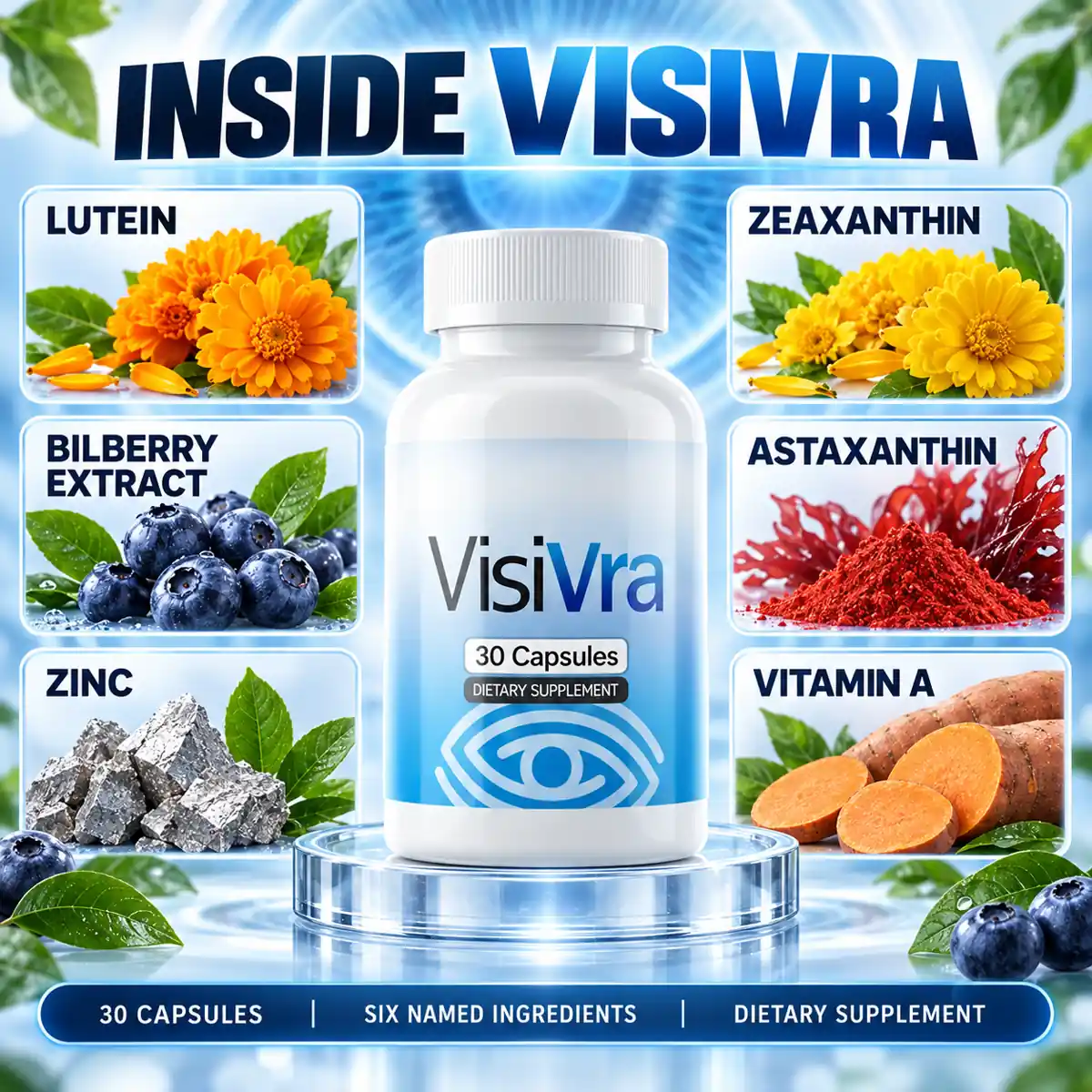
Visivra ingredients are six named actives: lutein, zeaxanthin, bilberry extract, astaxanthin, zinc and vitamin A. The front panel, the vendor’s ingredient tile and the seller’s own page all name the same six, and none of them prints an amount for any one. Five of the six have human eye trials behind them. This post covers what a bare ingredient name tells you, what it cannot, and the five things you can still judge.
- A name tells you an ingredient is present in some quantity above zero. That is genuinely all it tells you.
- In this category the amount is the evidence: the trials that built the shelf ran at specific figures in specific people.
- What a nameless quantity still permits is a judgement about selection, about form, about routine and about the seller.
- Two of the six have adult upper limits, which turns the missing figure from a value question into a stacking question.
- The one thing never worth doing is estimating. A plausible figure with a decimal point in it is a fabrication that looks like data.
What a name on a label actually means
Start with the narrowest true statement. An ingredient printed on a supplement label means the manufacturer put some of it in. Not how much, not in what form, not standardised to what marker, and not necessarily in a quantity that any published work would recognise.
That is not a conspiracy. In the United States a Supplement Facts panel is required and it must carry amounts, so a legally sold bottle has the figures somewhere. What varies is whether a buyer meets them before paying: a front panel, a marketing tile and a sales page can all name six ingredients and quantify none, and a buyer reading online has usually seen only those three.
That is exactly the position with this product. The front panel prints the wordmark, the capsule count, the words DIETARY SUPPLEMENT and an eye glyph. The vendor’s ingredient tile adds six names. The seller’s own page names the same six. Three documents, six names, no figures, which is set out in full on the label and amounts page.
Why the amount is the evidence in this category
Eye supplements are an unusually clean case of amounts mattering, because the whole shelf traces to a small number of trials that used specific figures.
AREDS2 gave lutein 10 mg and zeaxanthin 2 mg a day, for a median of five years. That pairing, at those two numbers, is why lutein and zeaxanthin are on every eye label sold today. A one-year trial in healthy young adults used the same pair at the same amounts and measured macular pigment, glare disability, photostress recovery and chromatic contrast.
The original AREDS formula used zinc 80 mg as zinc oxide WITH copper 2 mg as cupric oxide. Both halves of that were deliberate, and the copper was not decoration.
So a formula naming lutein could be at the trial figure, at a tenth of it, or at a token amount included so the word can appear on the front. Those are three different products and the name does not distinguish them.
| Ingredient | What the trials used | What a bare name permits |
|---|---|---|
| Lutein | lutein 10 mg and zeaxanthin 2 mg a day | Anything from a trial-equivalent amount to a token inclusion |
| Zeaxanthin | 2 mg a day, always beside the lutein | Same range, and no way to check the ratio between the two |
| Bilberry extract | 240 mg, 480 mg and 400 mg in three separate trials | Three trials disagree on the amount, so even a figure would need context |
| Astaxanthin | 4 mg a day for eighty-four days, in children | A real result at a known figure, in the wrong population for most buyers |
| Zinc | 80 mg with copper 2 mg in AREDS; a 25 mg arm in AREDS2 | The one where a missing figure is a safety question, not only a value one |
| Vitamin A | No eye-supplement trial amount exists to print | The form matters more than the number, and neither is given |
Every figure in the middle column was read out of the abstract of the trial it belongs to. None of them is a statement about what is in any particular capsule.
Order Visivra on the official website
Six named actives in one capsule a day, thirty to a bottle, with a 60-day money-back window that includes opened bottles.
Two bottles $158 · six bottles $294 · 60-day money-back guarantee
Order Visivra On The Official WebsiteOne capsule a day · 30 per bottle · lot VIS-26/VI-5716
Five things you can still judge
A label without quantities is not a blank. Five judgements survive it, and together they are most of a purchase decision.
Selection
Which six did the formulator choose? A list carrying both macular carotenoids is following the research; a list carrying one of them is not. A list padded with ingredients that have no human eye trial at all tells you something about the priorities behind it. On this label five of the six have human eye evidence, which is a better hit rate than a lot of the shelf manages.
What is absent
Copper beside zinc is the clearest example. A formula that names zinc and no copper is either running zinc low enough that it does not matter, or has not thought about it. You cannot tell which, but you can notice the question, and it is a better question than most people arrive with.
Form, where it is given
Vitamin A is the case in point. Preformed retinol and provitamin beta carotene behave completely differently in the body and carry completely different cautions. A label that says only vitamin A has declined to answer a question that matters more than the quantity does.
The routine
One capsule a day with food is easy to keep. Four capsules twice a day is not, and adherence quietly decides whether any supplement does anything. This is the one variable a buyer can assess perfectly from the outside.
The seller
Does the ladder start at one bottle or two? How long is the refund window, and does it include opened bottles? Is there a telephone number that answers? None of that is about the formula and all of it is about whether a mistake is recoverable. The 60-day window on the guarantee page is the part of this offer worth the most attention.
The stacking problem, which is different
There is one place where a missing amount stops being a value question and becomes a safety one, and it is worth separating from everything above.
Two of the six here have adult upper intake levels: zinc, and vitamin A in its preformed form. The Institute of Medicine zinc chapter is the primary source for the first. Both ingredients are also in almost every multivitamin sold, in cod liver oil, and in other eye formulas.
So a person taking a multivitamin and an eye supplement is taking some of both twice, and the arithmetic they would need to check it cannot be done from a label with no figures on it. That is not an argument against the product. It is an argument for asking the order desk before stacking, which is why the side effects page puts that question first.
Estimating. A reader who reasons that a six-ingredient capsule probably holds about 10 mg of lutein has produced a number with no source, and a number with no source is more dangerous than no number, because it can be added to other numbers. This desk prints trial amounts and labels them as the trials’, and it prints nothing else.
What to ask, and who can answer it
- How much of each of the six is in one capsule. The manufacturer knows; the label did not say.
- Which form the vitamin A takes, which decides whether it suits a smoker or former smoker.
- Whether copper is in the formula alongside the zinc.
- What the capsule shell is made of, given the vegetarian mark on the artwork.
All four go to the order desk rather than to this website, which cannot see an order and cannot supply a figure the label withheld. The contact page sets out which desk does what.
And the wider version of this question, applied to any bottle in the aisle rather than to this one, is the eight-point checklist on choosing a vision supplement. Check one on that list is this post in a sentence.
For the category’s own summary of what supplementation does and does not achieve, the Cochrane review is the least filtered starting point available.
What a quantified label would change
It is worth ending on the constructive version, because a post that only catalogues a gap leaves a reader with nothing to do.
With a lutein figure, a buyer could put this bottle beside the AREDS2 amount and see whether it is in the same territory or a fraction of it. That one comparison settles most of the value question in about ten seconds.
With a zinc figure, they could add it to whatever else they take and check the total against a published upper limit. That is a safety calculation rather than a value one, and it is currently impossible.
With a vitamin A form and figure, a smoker or former smoker could make an informed decision without telephoning anybody, which is the difference between a label that works and a label that defers.
And with a bilberry figure, a reader could see whether it sits near the 240 mg that moved ciliary muscle tone in a trial, or well below it.
Four questions, one document. That is the whole argument for a printed panel and it is why check one of the eight on choosing a vision supplement comes first rather than fifth.
References
- Lutein + zeaxanthin and omega-3 fatty acids for age-related macular degeneration: the Age-Related Eye Disease Study 2 (AREDS2) randomized clinical trial — Age-Related Eye Disease Study 2 (AREDS2) Research Group (JAMA, 2013;309(19):2005-15). PMID 23644932: https://pubmed.ncbi.nlm.nih.gov/23644932/
- A double-blind, placebo-controlled study on the effects of lutein and zeaxanthin on photostress recovery, glare disability, and chromatic contrast — Hammond BR, Fletcher LM, Roos F, et al (Invest Ophthalmol Vis Sci, 2014;55(12):8583-9). PMID 25468896: https://pubmed.ncbi.nlm.nih.gov/25468896/
- A randomized, placebo-controlled, clinical trial of high-dose supplementation with vitamins C and E, beta carotene, and zinc for age-related macular degeneration and vision loss: AREDS report no 8 — Age-Related Eye Disease Study Research Group (Arch Ophthalmol, 2001;119(10):1417-36). PMID 11594942: https://pubmed.ncbi.nlm.nih.gov/11594942/
- Zinc — Institute of Medicine (US) Panel on Micronutrients, In: Dietary Reference Intakes for Vitamin A, Vitamin K, Arsenic, Boron, Chromium, Copper, Iodine, Iron, Manganese, Molybdenum, Nickel, Silicon, Vanadium, and Zinc, Washington (DC): National Academies Press; 2001: https://www.ncbi.nlm.nih.gov/books/NBK222317/
- Antioxidant vitamin and mineral supplements for slowing the progression of age-related macular degeneration — Evans JR, Lawrenson JG (Cochrane Database Syst Rev, 2023;9(9):CD000254). PMID 37702300: https://pubmed.ncbi.nlm.nih.gov/37702300/