Visivra Official Website › Vision Supplement Guide
Vision Supplement GuideThe Vision Supplement Guide: What The Shelf Rests On
Two National Eye Institute trials built this entire category.
AREDS in 2001 and AREDS2 in 2013, both run in people who already had age-related macular degeneration. The Cochrane review of prevention in healthy eyes found no evidence of benefit. Macular pigment is the measure everything else is argued from, and it moves over months rather than days.
The longer piece: the origin, the population, the measure, the blue-light question, and what a good label in this category would print.
Where the eye supplement shelf came from
Two trials, thirty years of shelf marketing, and a gap between them worth understanding.
Almost everything in this aisle traces back to two trials run by the National Eye Institute, and understanding them explains why the labels look the way they do.
The first, AREDS, reported in 2001. It gave participants a high-dose antioxidant formula: vitamin C 500 mg, vitamin E 400 IU, beta carotene 15 mg, and zinc 80 mg as zinc oxide WITH copper 2 mg as cupric oxide. In people with intermediate disease it reduced progression to advanced age-related macular degeneration. That result is the foundation the whole category is built on.
The second, AREDS2, reported in 2013. It asked three questions: whether adding lutein and zeaxanthin helped, whether adding omega-3 helped, and whether beta carotene could be removed and the zinc lowered. It gave lutein 10 mg and zeaxanthin 2 mg a day, for a median of five years over a median of five years.
The answers were narrower than the marketing that followed. Lutein and zeaxanthin did not significantly beat placebo in the primary analysis. Omega-3 did nothing. Removing beta carotene made no difference to the outcome and removed the lung cancer signal in smokers, which is why it was removed. And the pre-specified secondary analysis did show lutein and zeaxanthin outperforming beta carotene, which is why they are now in the formula.
the National Eye Institute’s own account of both trials is the least filtered summary available and is worth reading before any marketing page in this category.
Who those trials were actually run in
This is the detail that changes how a healthy adult should read the whole category, and it is the one most often left out.
AREDS and AREDS2 enrolled people who already had age-related macular degeneration, mostly at the intermediate stage, and measured whether it progressed. They were treatment trials in a diagnosed population, not prevention trials in healthy eyes.
The Cochrane review that asked the prevention question directly found no evidence that antioxidant vitamin and mineral supplements prevent age-related macular degeneration from starting. The companion review, in people who already have it, is where the AREDS-style formulas earn their place.
So a healthy forty-five-year-old buying an eye supplement is not buying the AREDS result. They are buying an argument by extension: that keeping macular pigment topped up is sensible, that the tissue cannot make these molecules itself, and that a diet short of leafy greens is plausibly short of them too. That is a reasonable argument. It is not the same as a trial result, and a label that implies otherwise is overreaching.
Macular pigment, the measure everything is argued from
The macula is yellow, and the yellow is lutein, zeaxanthin and meso-zeaxanthin. It can be measured in a living eye as macular pigment optical density, and that measurement is the bridge between what you swallow and anything anybody can see.
It rises with intake. It rises more in people who started low. It rises over weeks to months rather than days, which is the honest reason a supplement in this category cannot be judged in a fortnight.
The meta-analysis of pigment against visual function is the fairest summary of what raising it associates with: glare disability, photostress recovery and contrast measures move more reliably than acuity does. The one-year trial measured all three directly at lutein 10 mg and zeaxanthin 2 mg a day for one year, 115 young adults, and a 2025 trial used lutein 10 mg and zeaxanthin 2 mg twice a day for four months in adults on screens eight hours a day.
The practical translation is unglamorous and useful. This is the part of vision that decides how long you are half blind after a set of oncoming headlights, and how quickly a room resolves when you come in from bright sun. It is not the letter chart, and a category sold on sharper vision is selling the wrong thing.
Screens, blue light and what the evidence supports
Blue light is the marketing engine of this category's newer half, and it is where the gap between mechanism and evidence is widest.
The mechanism is genuine. Macular pigment absorbs short-wavelength light, and that is a measured physical property rather than a hypothesis. What does not follow from it is that filtering blue light produces a benefit anyone can detect.
The Cochrane review of blue-light filtering spectacle lenses is the best test the proposition has had. It found no evidence of a short-term benefit for eye strain, no clear effect on visual performance, and nothing on macular health. That is lenses rather than capsules, and it is the closest evidence the question has.
The TFOS Lifestyle report on the digital environment arrives at the same place from the other direction and is more useful, because it says what does matter: blink rate falls sharply during concentrated screen work, tear film breaks up, room light and screen position matter, and an out-of-date correction makes everything worse. A randomised blink-training trial is one of very few interventions in this space with a controlled result.
None of that argues against a carotenoid habit. It argues against expecting one to fix a problem whose main drivers are behavioural and optical.
The ingredients beyond the AREDS core, ranked by evidence
| Ingredient | Human eye evidence | Amount the trials used | How to read it |
|---|---|---|---|
| Lutein and zeaxanthin | Strong, and the reason the shelf exists | lutein 10 mg and zeaxanthin 2 mg a day, for a median of five years | The anchor. A formula without both is missing the category's core. |
| Zinc | Strong, as part of a formula rather than alone | zinc 80 mg as zinc oxide WITH copper 2 mg as cupric oxide | Check for copper beside it, and check the total against anything else you take. |
| Vitamin A | Essential to vision; no eye-supplement trial amount | No trial amount exists to print | Read the form before the figure. It decides whether it suits you. |
| Bilberry | Three small trials, all about fatigue and focusing | 240 mg, 480 mg and 400 mg in three separate trials | Promising for screen comfort. Not a retinal ingredient. |
| Astaxanthin | One good 2025 trial, in children | 4 mg of astaxanthin a day for eighty-four days, in children aged 10 to 14 | Real result, wrong population for most buyers. Watch this space. |
| Omega-3 | Tested directly in AREDS2 and found not to help | DHA 350 mg and EPA 650 mg a day | Its absence from a formula is evidence-led rather than a gap. |
The amounts are the trials', every one read out of the abstract itself. None of them is a recommendation and none is a label figure.
What a good label in this category looks like
Pulling the whole guide together, here is what a considered eye supplement label prints, and each item is on the list because its absence makes something unanswerable.
- An amount for every named active, with no proprietary blend total.
- Lutein and zeaxanthin both present, at roughly the ratio the trials used.
- Copper named beside the zinc, if the zinc is meaningful.
- The form of the vitamin A, spelled out, not just the words vitamin A.
- The capsule shell material, so a vegetarian mark can be checked.
- A serving size and a directions line, so the arithmetic is not left to the buyer.
- A lot number and a best-before date, printed where they can be read.
- A refund window of at least sixty days that includes opened bottles.
Very few labels print all eight. The point of the list is not to reject everything, it is to know what you are giving up when you accept a bottle that leaves items off it, and to price that into the decision.
The one thing worth more than any of this
An eye examination finds the things that matter, and most of them are not nutritional.
A test measures pressure, looks at the optic nerve, images the retina, and checks whether the correction you are wearing is the one you now need. It finds glaucoma before it takes any field, picks up diabetic change before it is symptomatic, and catches macular change at the stage where the AREDS formula is actually indicated.
And for the single modifiable risk factor with the largest measured effect, a 2025 review of smoking and ocular health is the reference. Nothing on a supplement shelf comes close to it in either direction.
A daily capsule is a reasonable thing to add to a life that already includes those. It is a poor substitute for any of them, and the honest version of this guide has to end by saying so.
Who publishes this Visivra website?
- Age-Related Eye Disease Study Research Group. A randomized, placebo-controlled, clinical trial of high-dose supplementation with vitamins C and E, beta carotene, and zinc for age-related macular degeneration and vision loss: AREDS report no. 8. Arch Ophthalmol. 2001;119(10):1417-36. PMID 11594942. https://pubmed.ncbi.nlm.nih.gov/11594942/
- Age-Related Eye Disease Study 2 (AREDS2) Research Group. Lutein + zeaxanthin and omega-3 fatty acids for age-related macular degeneration: the Age-Related Eye Disease Study 2 (AREDS2) randomized clinical trial. JAMA. 2013;309(19):2005-15. PMID 23644932. https://pubmed.ncbi.nlm.nih.gov/23644932/
- Chew EY, Clemons TE, Sangiovanni JP, et al. Secondary analyses of the effects of lutein/zeaxanthin on age-related macular degeneration progression: AREDS2 report No. 3. JAMA Ophthalmol. 2014;132(2):142-9. PMID 24310343. https://pubmed.ncbi.nlm.nih.gov/24310343/
- National Eye Institute. Age-Related Eye Disease Studies (AREDS/AREDS2). Bethesda (MD): National Institutes of Health. https://www.nei.nih.gov/research/clinical-trials/age-related-eye-disease-studies-aredsareds2
- Evans JR, Lawrenson JG. Antioxidant vitamin and mineral supplements for preventing age-related macular degeneration. Cochrane Database Syst Rev. 2017;7(7):CD000253. PMID 28756617. https://pubmed.ncbi.nlm.nih.gov/28756617/
- Evans JR, Lawrenson JG. Antioxidant vitamin and mineral supplements for slowing the progression of age-related macular degeneration. Cochrane Database Syst Rev. 2023;9(9):CD000254. PMID 37702300. https://pubmed.ncbi.nlm.nih.gov/37702300/
- Johnson EJ, Avendano EE, Mohn ES, et al. The association between macular pigment optical density and visual function outcomes: a systematic review and meta-analysis. Eye (Lond). 2021;35(6):1620-1628. PMID 32792595. https://pubmed.ncbi.nlm.nih.gov/32792595/
- Hammond BR, Fletcher LM, Roos F, et al. A double-blind, placebo-controlled study on the effects of lutein and zeaxanthin on photostress recovery, glare disability, and chromatic contrast. Invest Ophthalmol Vis Sci. 2014;55(12):8583-9. PMID 25468896. https://pubmed.ncbi.nlm.nih.gov/25468896/
- Bharadwaj VG, Mb T, Hv A, et al. Beneficial Effects of a Lutein-Zeaxanthin Complex on Macular Pigment Optical Density Levels of Healthy Individuals With Prolonged Screen Time. Cureus. 2025;17(2):e79481. PMID 40135032. https://pubmed.ncbi.nlm.nih.gov/40135032/
- Singh S, Keller PR, Busija L, et al. Blue-light filtering spectacle lenses for visual performance, sleep, and macular health in adults. Cochrane Database Syst Rev. 2023;8(8):CD013244. PMID 37593770. https://pubmed.ncbi.nlm.nih.gov/37593770/
- Wolffsohn JS, Lingham G, Downie LE, et al. TFOS Lifestyle: Impact of the digital environment on the ocular surface. Ocul Surf. 2023;28:213-252. PMID 37062428. https://pubmed.ncbi.nlm.nih.gov/37062428/
- Ashwini DL, Ve RS, Nosch D, et al. Efficacy of blink software in improving the blink rate and dry eye symptoms in visual display terminal users - A single-blinded randomized control trial. Indian J Ophthalmol. 2021;69(10):2643-2648. PMID 34571605. https://pubmed.ncbi.nlm.nih.gov/34571605/
- Hecht KA, Marwah M, Wood V, et al. Astaxanthin (AstaReal) Improved Acute and Chronic Digital Eye Strain in Children: A Randomized Double-Blind Placebo-Controlled Trial. Adv Ther. 2025;42(4):1811-1833. PMID 40014233. https://pubmed.ncbi.nlm.nih.gov/40014233/
- Kosehira M, Machida N, Kitaichi N. A 12-Week-Long Intake of Bilberry Extract (Vaccinium myrtillus L.) Improved Objective Findings of Ciliary Muscle Contraction of the Eye: A Randomized, Double-Blind, Placebo-Controlled, Parallel-Group Comparison Trial. Nutrients. 2020;12(3). PMID 32106548. https://pubmed.ncbi.nlm.nih.gov/32106548/
- Asiamah R, Ampo E, Ampiah EE, et al. Impact of smoking on ocular health: A systematic review and meta-meta-analysis. Eur J Ophthalmol. 2025;35(4):1506-1518. PMID 40239176. https://pubmed.ncbi.nlm.nih.gov/40239176/
Order Visivra knowing what the category rests on
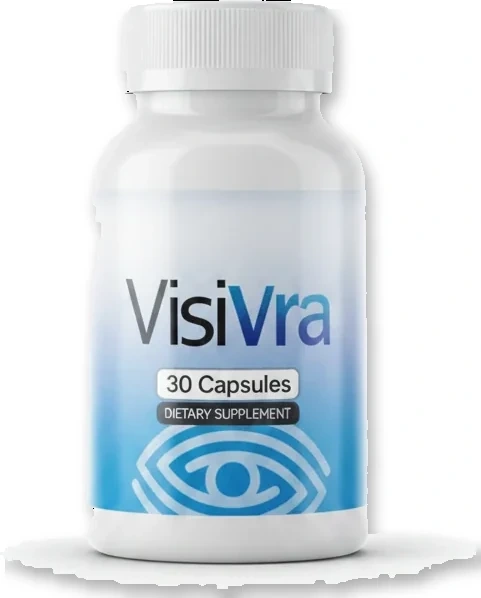
This bottle carries the two anchor carotenoids and four more names. What it does not carry is a figure for any of them, and this desk says so on every page.
Two bottles $158 · six bottles $294 · 60-day money-back guarantee
Order Visivra On The Official WebsiteOne capsule a day · 30 per bottle · lot VIS-26/VI-5716