Glaucoma And Eye Supplements: What The Studies Do And Do Not Show
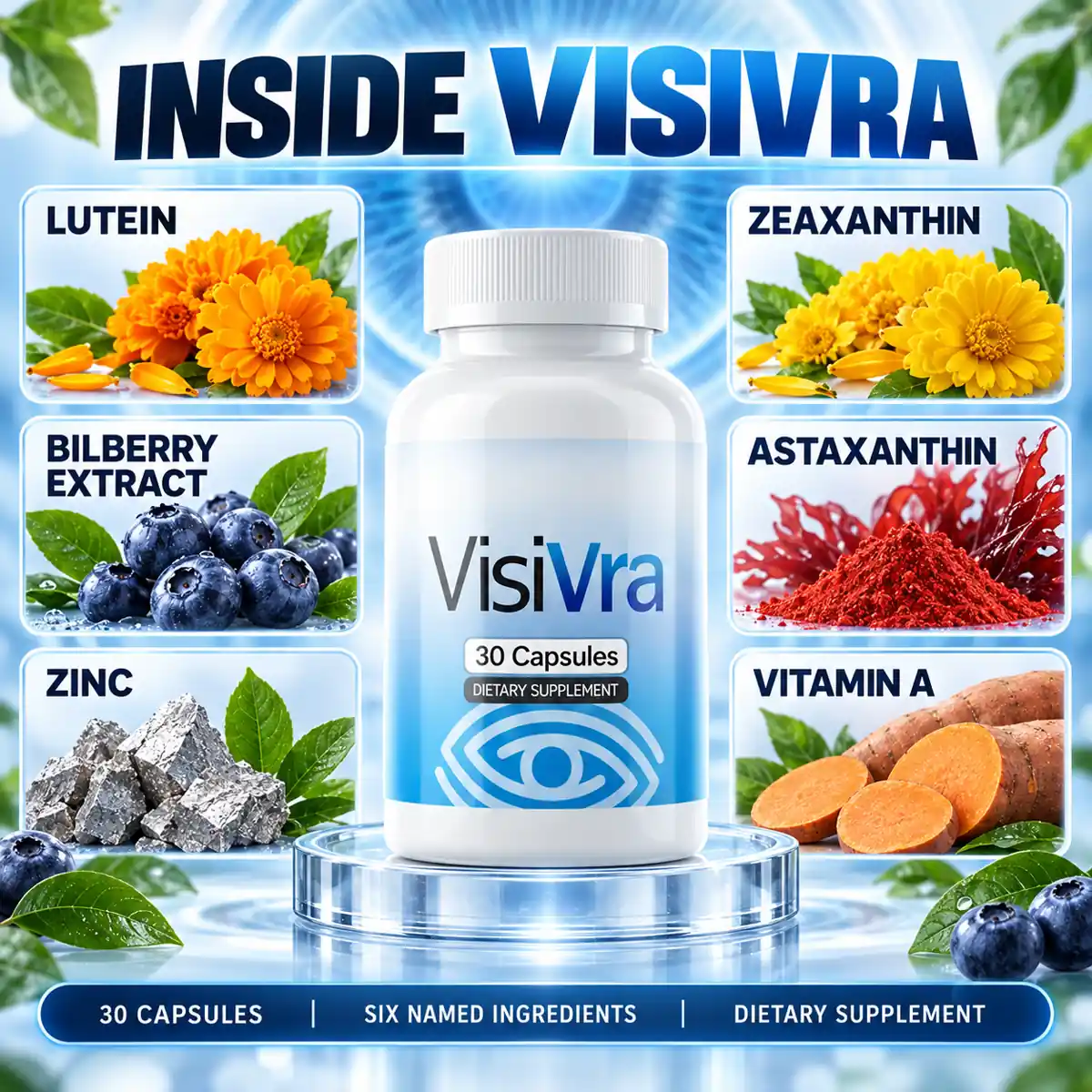
Glaucoma runs in families, it rarely announces itself, and a person who has just been told they are “a suspect” will reasonably wonder whether the eye capsule on the shelf could help. Visivra names six ingredients and prints no amounts for any of them. This post takes the six names and asks a narrow question: what do the published studies show about them and glaucoma, and what did the trials that made these ingredients famous actually measure?
- The trials behind lutein, zeaxanthin and zinc were about age-related macular degeneration. They measured progression to advanced macular disease, not eye pressure, optic-nerve thickness or visual-field loss.
- The two large US cohorts that looked at carotenoids and vitamin A found no strong link with primary open-angle glaucoma. A Rotterdam cohort found a link with retinol equivalents, and a US survey found none.
- The one randomized lutein, zeaxanthin and meso-zeaxanthin trial in people with glaucoma raised macular pigment and moved one glare-contrast measure. The nerve-fibre and ganglion-cell measures did not change.
- The only randomized glaucoma trial found in this ingredient family used black currant anthocyanins, not bilberry, in 38 people on eye drops. It is small and it has not been the last word.
- What is proven in glaucoma is lowering eye pressure. Whether that is needed is found by an examination, not by how your eyes feel, which is why the exam outranks any capsule.
- Visivra’s label prints no glaucoma claim and no amounts. Nothing on this page states what is in the capsule.
What glaucoma is, in the terms trials use
Glaucoma is best thought of as a slow loss of the optic nerve, the cable that carries what the retina sees to the brain. The damage shows up on an examination as a change in the appearance of the nerve head, as a thinning of the nerve-fibre layer on a scan, and as gaps that open in the field of vision, often beginning away from the centre. Those three things, and the pressure inside the eye, are the vocabulary of every glaucoma trial.
It is not rare. A systematic review of 50 population-based studies estimated that 3.54% of people aged 40 to 80 worldwide have glaucoma, which the authors turned into 64.3 million people in 2013 and a projected 111.8 million by 2040. An earlier prevalence model put the figure at 60.5 million in 2010 and described glaucoma as the second leading cause of blindness worldwide. The US Preventive Services Task Force, in its 2022 statement, puts the US figure at an estimated 2.7 million people.
Two features of that literature matter for the rest of this page. First, treatment is built on one modifiable factor. A 2026 review of vitamins and nutraceuticals in glaucoma opens by saying there is no cure and that the disease is managed by lowering intraocular pressure, and a 2025 review of diet and lifestyle in glaucoma calls pressure lowering the only proven treatment. Second, a lot of the disease is found by looking rather than by anyone complaining. Hold onto that; it is where this post ends up.
What the treatment trials measured
It helps to see what a solid glaucoma result looks like before asking whether a supplement has one.
The Ocular Hypertension Treatment Study randomized 1,636 people who had raised eye pressure but no sign of glaucomatous damage to either observation or pressure-lowering drops. Pressure in the treated group fell by an average of 22.5% against 4.0% in the observed group. At 60 months the cumulative probability of developing primary open-angle glaucoma, defined by reproducible visual-field abnormality or optic-disc deterioration judged by masked readers, was 4.4% in the treated group and 9.5% in the observed group, a hazard ratio of 0.40. The authors were careful to add that this did not mean everyone with borderline pressure needs medication.
The Early Manifest Glaucoma Trial then asked what happens once glaucoma has been found. It randomized 255 people aged 50 to 80 with early field loss, mainly identified through a population screening, to laser plus a pressure-lowering drop or to no initial treatment. Treatment cut pressure by an average of 5.1 mm Hg, about 25%. After a median of six years progression had occurred in 45% of treated people and 62% of controls.
Not every result was that tidy. In the Collaborative Normal-Tension Glaucoma Study, 145 people whose pressure was in the statistically normal range had one eye randomized to a 30% pressure reduction or to no treatment. In the straight intent-to-treat comparison the two groups progressed at indistinguishable rates, 22 of 66 against 31 of 79. When cataract, which the surgical treatment tended to cause, was taken out of the analysis, the treated eyes did significantly better. The authors concluded that lowering pressure without producing cataract is beneficial, and also that because not every untreated patient progressed, the natural history has to be weighed before committing anyone to treatment.
Notice what these trials share. They used pressure as the intervention, they followed for years, and their endpoints were the disc and the field. A supplement claiming a role in glaucoma would have to be measured on those same endpoints, against a control group, over a similar span. That is the bar. The next sections look at whether any of the six names on the Visivra tile has been held to it.
What the supplement trials that made these ingredients famous measured
Lutein, zeaxanthin and zinc all owe their place on eye-supplement labels to two trials, and both were about the macula, not the optic nerve.
The original Age-Related Eye Disease Study gave people at risk of macular degeneration one of four daily regimens: antioxidants (vitamin C 500 mg, vitamin E 400 IU and beta carotene 15 mg), zinc 80 mg as zinc oxide with copper 2 mg as cupric oxide, both, or placebo. Its endpoints were photographic progression to advanced macular degeneration and moderate loss of visual acuity. Its follow-up averaged 6.3 years in 3,640 participants. Antioxidants plus zinc reduced the odds of advanced macular degeneration (odds ratio 0.72); zinc alone had an odds ratio of 0.75 whose interval just crossed 1.
AREDS2 then tested lutein 10 mg with zeaxanthin 2 mg, omega-3 fatty acids, or both, on top of the original formula, in 4,203 people at risk of advanced macular degeneration, for a median of five years. The primary analyses found no statistically significant reduction in progression to advanced macular degeneration from adding lutein and zeaxanthin.
Those are the amounts the trials used, and they are not amounts printed anywhere on a Visivra bottle. What matters here is the endpoint. Neither trial measured intraocular pressure. Neither measured optic-nerve structure or visual-field loss as a glaucoma outcome. So when a page, this one included, talks about the evidence behind lutein or zinc, it is talking about macular disease. Reading that evidence as glaucoma evidence borrows credit from a different condition.
What the cohort and survey studies say about carotenoids and vitamin A
If there is no trial, the next-best evidence is observational: follow large groups, record what they eat or take, and see who develops glaucoma. There are a handful of these, and they do not agree.
The largest is a pooled analysis of the Nurses’ Health Study and the Health Professionals Follow-up Study, which followed 76,200 women from 1980 and 40,284 men from 1986, all over 40, through 1996 and counted 474 confirmed cases of primary open-angle glaucoma with field loss. Comparing the highest against the lowest fifth of intake, the rate ratio was 0.92 for lutein and zeaxanthin (95% confidence interval 0.69 to 1.24), 1.11 for vitamin A (0.82 to 1.51) and 1.10 for beta carotene (0.82 to 1.48). The authors’ verdict: no strong associations between antioxidant consumption and the risk of the disease.
The Rotterdam Study reached a more interesting answer. It followed 3,502 people aged 55 and over, free of glaucoma at the start, for an average of 9.7 years, during which 91 of them developed it. Across the many nutrients examined, three stood out: people in the highest third of retinol-equivalent intake had a hazard ratio of 0.45 (0.23 to 0.90) compared with the lowest third, vitamin B1 was similarly lower at 0.50, and magnesium went the other way at 2.25. The authors noted the effects were stronger after excluding people who took supplements. That last detail is the one a capsule buyer should sit with: the signal, such as it was, sat in the diet.
A third source, a cross-sectional analysis of 2,912 adults in a US national survey, compared self-reported glaucoma with vitamin supplement use and with blood levels. Neither supplemental vitamin A nor serum vitamin A was associated with glaucoma; the odds ratio for the highest quartile of supplemental vitamin A against none was 0.48, with an interval running from 0.13 to 1.82, which is another way of saying the study could not tell. The one supplement association that reached significance was for vitamin C, and blood vitamin C did not correlate.
Set those against a 2025 analysis of 4,909 people in the same US survey series, which scored a 16-part dietary oxidative balance and found that each unit higher was linked to a 4% lower odds of self-reported glaucoma. That is a diet-pattern result, cross-sectional, self-reported, and it does not isolate lutein, zinc or a capsule. And a Mendelian randomization study that used genetic variants as a proxy for lifelong blood levels of retinol, beta carotene, vitamin C, lycopene and two forms of vitamin E found no causal association with primary open-angle glaucoma, eye pressure, nerve-fibre-layer thickness, ganglion-cell thickness or cup-to-disc ratio.
The reviews summarizing all this are appropriately cautious. A scoping review of diet and glaucoma mapped 19 studies published from 2003 to 2023 and found that about 80% reported some significant association, but 95% were observational and only one was a randomized trial. A 2025 review says carotenoids including lutein and zeaxanthin, flavonoids including anthocyanins, and B vitamins have a strong biological rationale but limited support from long-term, large population-based studies, while higher dietary nitrate from leafy greens was the most consistent finding. A 2025 review specifically on vitamin A calls the results conflicting, mostly cross-sectional, with several meta-analyses leaning toward a benefit of dietary intake; it is a fair reminder that dietary retinol and beta carotene from food are not the same exposure as a supplement whose form the label does not name.
Lutein and zeaxanthin in eyes that already have glaucoma
The most relevant trial for these two ingredients is a double-masked, randomized, placebo-controlled study in 62 people with open-angle glaucoma, 42 on the active supplement and 20 on placebo, followed for 18 months. The active formulation was lutein 10 mg, zeaxanthin 2 mg and meso-zeaxanthin 10 mg. Those are the trial’s amounts, not Visivra’s.
What happened is worth stating in both directions. Macular pigment optical density volume rose steadily in the treated group and did not move in the placebo group, so the capsules did what carotenoid capsules do to the pigment. A measure of contrast sensitivity under glare in mesopic light was higher at 18 months in the treatment group and not in placebo. But the authors report that no other structural or functional changes were observed, and the structural measures included retinal nerve fibre layer and ganglion cell complex thickness, which are the glaucoma endpoints. The conclusion they draw is modest: macular pigment can be augmented in glaucomatous eyes and the potential benefit merits longer study.
A 2025 cross-sectional study of 121 patients with primary open-angle glaucoma looked from the other direction: did people with more macular pigment have better field sensitivity or thicker nerve layers? Macular pigment optical volume showed no significant association with visual-field sensitivity, ganglion cell complex thickness or nerve-fibre-layer thickness. The authors read that as no structural or functional link between the pigment and glaucomatous damage.
Put together, the fair summary is that macular pigment is raisable in a glaucoma patient, the raising has been tied to one glare-contrast measure in one small trial, and nobody has shown it protecting the optic nerve. Anyone selling lutein as a glaucoma supplement is claiming something the studies above do not say.
Bilberry, zinc, astaxanthin and the rest
The closest thing to a glaucoma trial in this family involves an anthocyanin, the same pigment family that gives bilberries their colour, but not bilberry. A two-year, double-masked trial gave black currant anthocyanins, 50 mg a day, or placebo to 38 people with open-angle glaucoma who were already on eye drops. The main outcome was change in visual-field mean deviation. The difference between groups at 24 months reached statistical significance (p = 0.039), ocular blood flow measured by laser speckle rose in the treated group, and intraocular pressure did not change. The authors called black currant anthocyanins a safe and promising add-on to medication.
That is a real, randomized, two-year result, and it deserves more than a shrug. It is also 38 people, from one research group, using a different berry from the one on the Visivra tile, at an amount that says nothing about the capsule. Ask for it to be repeated before treating it as settled, and do not read it as a bilberry result. For bilberry itself, the best-known eye review is a systematic review of night-vision trials, which found the idea that bilberry anthocyanosides improve normal night vision unsupported by rigorous studies and noted a complete absence of rigorous research in people with pathological eye conditions.
For zinc and astaxanthin, the searches behind this page found no randomized trial with a glaucoma endpoint. That is a statement about a search, not a proof that nothing exists, and it is only one part of the picture; zinc’s trial history is a macular degeneration story, which the section above covers.
| Named on the label | Best evidence found for glaucoma | What it measured | Reading it fairly |
|---|---|---|---|
| Lutein and zeaxanthin | Randomized trial, 62 people with glaucoma, 18 months | Macular pigment, glare contrast, nerve-fibre and ganglion-cell thickness | Pigment rose; nerve measures did not change |
| Vitamin A | Cohorts and a national survey | Diet or supplement use against diagnosed glaucoma | Conflicting; one cohort favourable, two null; form not captured on the label |
| Bilberry extract | None directly; a black currant anthocyanin trial in 38 people | Visual-field mean deviation over 24 months | Interesting, small, different berry |
| Zinc | None found | Not applicable | Its trials were in macular degeneration |
| Astaxanthin | None found | Not applicable | No glaucoma trial located |
Every figure in the table was read from the abstract of the study named in the text above. None describes what is in a Visivra capsule.
Why a symptomless disease makes the exam matter more than the capsule
Here is the practical point. The Early Manifest Glaucoma Trial recruited people whose glaucoma was, in the authors’ words, mainly identified through a population screening. The Task Force statement is written about adults over 40 who, in its words, have no signs or symptoms of open-angle glaucoma. In other words the disease is routinely found in people who felt fine. Someone taking a capsule for “visual clarity” or “long-term eye wellness” can feel fine for years while pressure or nerve damage progresses, and the feeling of having done something for their eyes is exactly the thing that can put off an appointment.
There is also an honest limit on what screening itself has proved. The Task Force’s 2022 conclusion was that the evidence is insufficient to assess the balance of benefits and harms of screening for glaucoma in adults, an “I statement”. That is a finding about routine screening of people without symptoms in a primary care setting. It is not a finding that examinations are useless, and it does not touch a person with a family history, high pressure, or a change in their vision, where an eye professional decides what testing is warranted. It does mean nobody should present a supplement as a substitute for finding out.
The kind of check that matters is the one that measures the things the trials measured: pressure, the appearance of the optic nerve, and the visual field. If you want the longer list of what an eye examination finds and a capsule cannot, that is the subject of another post on this site, which this one deliberately does not repeat.
What to do with all of this
- If you have been diagnosed or told you are a suspect, the medicine that is proven is the one your eye doctor prescribed. A capsule is not a replacement for drops, laser or surgery, and nothing on this page is a reason to skip or stop a prescription.
- Before adding any eye capsule, bring the bottle to the appointment. Ask specifically about the vitamin A, because the label names it without saying whether it is preformed vitamin A or a carotenoid that the body converts, and about zinc, for the same reason.
- If you have not had an examination in a while, book it for its own sake. Tell the examiner if a close relative has glaucoma.
- Read claims against endpoints. A page that says lutein is “good for glaucoma” should be able to name the trial, the endpoint and the amount. The trials that exist measured the macula, macular pigment, or the field in a few dozen people.
Of the six names on the Visivra tile, only lutein and zeaxanthin have been given to people with glaucoma in a randomized trial, and that trial moved macular pigment and one glare measure without changing the nerve, so the only thing that matters more than any of these is finding out, by examination, whether you need pressure lowered.
Where the Visivra label fits
The front panel prints a wordmark, 30 Capsules, DIETARY SUPPLEMENT and an eye glyph, and the supplier’s ingredient tile adds six names. The supports stated for the product are visual clarity, healthy retinal function, long-term eye wellness and help defending eyes from blue-light exposure; glaucoma is not among them, and nothing on this site says the capsule does anything for it. The label and amounts page transcribes the panel, the benefits page sets out each stated support beside the trials behind it, and Six Names, No Milligrams explains why a name without an amount is an incomplete claim. If you are already taking medicine for your eyes, the companion post on medicines and eye capsules lists the questions to put to a pharmacist.
Order Visivra
Six named ingredients in a capsule, thirty capsules to a bottle. Read the label page first, then decide.
Order Visivra30 capsules per bottle · six named ingredients
References
- Tham YC, Li X, Wong TY, et al. Global prevalence of glaucoma and projections of glaucoma burden through 2040: a systematic review and meta-analysis. Ophthalmology. 2014;121(11):2081-90. PMID 24974815. https://pubmed.ncbi.nlm.nih.gov/24974815/
- Quigley HA, Broman AT. The number of people with glaucoma worldwide in 2010 and 2020. Br J Ophthalmol. 2006;90(3):262-7. PMID 16488940. https://pubmed.ncbi.nlm.nih.gov/16488940/
- US Preventive Services Task Force, Mangione CM, Barry MJ, et al. Screening for Primary Open-Angle Glaucoma: US Preventive Services Task Force Recommendation Statement. JAMA. 2022;327(20):1992-1997. PMID 35608574. https://pubmed.ncbi.nlm.nih.gov/35608574/
- Kass MA, Heuer DK, Higginbotham EJ, et al. The Ocular Hypertension Treatment Study: a randomized trial determines that topical ocular hypotensive medication delays or prevents the onset of primary open-angle glaucoma. Arch Ophthalmol. 2002;120(6):701-13; discussion 829-30. PMID 12049574. https://pubmed.ncbi.nlm.nih.gov/12049574/
- Heijl A, Leske MC, Bengtsson B, et al. Reduction of intraocular pressure and glaucoma progression: results from the Early Manifest Glaucoma Trial. Arch Ophthalmol. 2002;120(10):1268-79. PMID 12365904. https://pubmed.ncbi.nlm.nih.gov/12365904/
- Collaborative Normal-Tension Glaucoma Study Group. The effectiveness of intraocular pressure reduction in the treatment of normal-tension glaucoma. Am J Ophthalmol. 1998;126(4):498-505. PMID 9780094. https://pubmed.ncbi.nlm.nih.gov/9780094/
- Age-Related Eye Disease Study 2 Research Group. Lutein + zeaxanthin and omega-3 fatty acids for age-related macular degeneration: the Age-Related Eye Disease Study 2 (AREDS2) randomized clinical trial. JAMA. 2013;309(19):2005-15. PMID 23644932. https://pubmed.ncbi.nlm.nih.gov/23644932/
- Age-Related Eye Disease Study Research Group. A randomized, placebo-controlled, clinical trial of high-dose supplementation with vitamins C and E, beta carotene, and zinc for age-related macular degeneration and vision loss: AREDS report no. 8. Arch Ophthalmol. 2001;119(10):1417-36. PMID 11594942. https://pubmed.ncbi.nlm.nih.gov/11594942/
- Kang JH, Pasquale LR, Willett W, et al. Antioxidant intake and primary open-angle glaucoma: a prospective study. Am J Epidemiol. 2003;158(4):337-46. PMID 12915499. https://pubmed.ncbi.nlm.nih.gov/12915499/
- Ramdas WD, Wolfs RC, Kiefte-de Jong JC, et al. Nutrient intake and risk of open-angle glaucoma: the Rotterdam Study. Eur J Epidemiol. 2012;27(5):385-93. PMID 22461101. https://pubmed.ncbi.nlm.nih.gov/22461101/
- Wang SY, Singh K, Lin SC. Glaucoma and vitamins A, C, and E supplement intake and serum levels in a population-based sample of the United States. Eye (Lond). 2013;27(4):487-94. PMID 23429409. https://pubmed.ncbi.nlm.nih.gov/23429409/
- Yang Y, Zhang H, Wu X, et al. Antioxidant-rich diets and glaucoma prevention: Insights from dietary oxidative balance scores in NHANES 2005-2008. Eye (Lond). 2025;39(13):2527-2533. PMID 40629038. https://pubmed.ncbi.nlm.nih.gov/40629038/
- Xiong K, Zhang Q, Mao H, et al. Assessment of Causality Between Diet-Derived Antioxidants and Primary Open-Angle Glaucoma: A Mendelian Randomization Study. Transl Vis Sci Technol. 2024;13(2):20. PMID 38411971. https://pubmed.ncbi.nlm.nih.gov/38411971/
- Edokpa GD, McFarlane SR. Glaucoma and dietary intake: a scoping review. Front Nutr. 2024;11:1497366. PMID 39720355. https://pubmed.ncbi.nlm.nih.gov/39720355/
- Hanyuda A, Tsuda S, Himori N, et al. Diet, Exercise, and Lifestyle in Glaucoma: Current Evidence and Future Perspectives. Nutrients. 2025;17(21). PMID 41228444. https://pubmed.ncbi.nlm.nih.gov/41228444/
- Zhang X, Yang H, Zhou X, et al. Potential benefits of vitamin A and its derivatives in glaucoma. Eur J Med Res. 2025;30(1):527. PMID 40597446. https://pubmed.ncbi.nlm.nih.gov/40597446/
- Hui F, Williams PA. Vitamins and nutraceuticals in glaucoma research. Eur J Ophthalmol. 2026;36(3):512-528. PMID 41637226. https://pubmed.ncbi.nlm.nih.gov/41637226/
- Loughman J, Loskutova E, Butler JS, et al. Macular Pigment Response to Lutein, Zeaxanthin, and Meso-zeaxanthin Supplementation in Open-Angle Glaucoma: A Randomized Controlled Trial. Ophthalmol Sci. 2021;1(3):100039. PMID 36247822. https://pubmed.ncbi.nlm.nih.gov/36247822/
- Matsumura N, Asaoka R, Fujino Y, et al. The Relationship Between Macular Pigment Optical Volume and Visual Function in Glaucoma Patients. Invest Ophthalmol Vis Sci. 2025;66(11):31. PMID 40801675. https://pubmed.ncbi.nlm.nih.gov/40801675/
- Ohguro H, Ohguro I, Katai M, et al. Two-year randomized, placebo-controlled study of black currant anthocyanins on visual field in glaucoma. Ophthalmologica. 2012;228(1):26-35. PMID 22377796. https://pubmed.ncbi.nlm.nih.gov/22377796/
- Canter PH, Ernst E. Anthocyanosides of Vaccinium myrtillus (bilberry) for night vision--a systematic review of placebo-controlled trials. Surv Ophthalmol. 2004;49(1):38-50. PMID 14711439. https://pubmed.ncbi.nlm.nih.gov/14711439/