How Long Does Lutein Take to Work? A Week-by-Week Timeline From the Actual Trials
Quick Answer: How Long Does Lutein Take to Work?
Three different things happen on three different clocks — blood levels in about two weeks, macular pigment over roughly three to five months, and any measurable change in visual performance somewhere between 12 weeks and a year. The honest minimum before you judge whether a lutein supplement is doing anything is 8 to 12 weeks of consistent daily use, because that is the earliest point at which any published trial recorded a change in how well people actually saw.
- Day 15: serum lutein plateaus at roughly 2.4 times baseline and stays there (n=24, 6 mg/day).
- Day 20 to 140: macular pigment optical density climbs steadily once loading is done.
- Week 12 to month 12: contrast sensitivity and photostress recovery are the endpoints that moved.
- Never: visual acuity and spectacle prescription do not change on any timeline.
Why every article gives you a different number
Search this question and you will be told two weeks, three months, six months and "up to a year", sometimes on the same page. None of those answers is wrong. They answer different questions, and the pages giving them rarely say which. Lutein supplementation has three separate measurable endpoints, and each has its own clock:
- Serum lutein — how much lutein is circulating in your blood. Fastest. Plateaus in about two weeks.
- Macular pigment optical density (MPOD) — how much of that lutein has actually been deposited in the retina. Slow. Months.
- Visual performance — contrast sensitivity, recovery from a bright flash, chromatic contrast. Slowest, and the only one you could conceivably notice.
Blood is not retina, and retina is not vision. Compressing all three into one number is the reason so many people conclude after three weeks that nothing is happening. On the published evidence, at three weeks nothing should be happening yet, other than in your bloodstream.
The lutein timeline, endpoint by endpoint
Here is what was actually measured, in whom, at what dose, and for how long. Every row is a specific published trial, not a marketing phase.
| Window | What measurably changes | Endpoint measured | Dose and duration in the trial | Source |
|---|---|---|---|---|
| Day 0 to 15 | Serum lutein rises about 2.4-fold, from 0.36 to 0.81–0.90 µmol/L, then stops rising | Serum lutein concentration | 6 mg/day marigold lutein, free or ester form; n=24 crossover | Olmedilla-Alonso et al., Nutrients 2024;16(10):1415 · PMID 38794653 |
| Day 15 to 60 | Serum holds the plateau. No further increase from continued dosing | Serum lutein concentration | Same trial, 2-month supplementation periods | Olmedilla-Alonso et al., Nutrients 2024 · PMID 38794653 |
| Day 20 to 140 | MPOD begins rising 20 to 40 days in, at 1.13 ± 0.12 milliabsorbance units/day; total rise 39% and 21% | Macular pigment optical density | 30 mg/day free lutein, 140 days; n=2 | Landrum et al., Exp Eye Res 1997;65(1):57–62 · PMID 9237865 |
| 8 weeks to 24 months (pooled) | MPOD rises 0.09 optical density units vs placebo in healthy people and 0.07 in people with AMD; about 0.004–0.005 ODU per additional 1 mg/day | Macular pigment optical density | 0–20 mg/day across 20 randomised trials; 938 AMD and 826 healthy participants | Ma et al., Nutrients 2016;8(7):426 · PMID 27420092 |
| Week 12 | Contrast sensitivity improved in both lutein arms, reaching significance at most visual angles in the 12 mg arm. Visual acuity and glare sensitivity did not change | Contrast sensitivity; visual acuity; glare sensitivity | 6 or 12 mg/day vs placebo, 12 weeks; n=37, aged 22–30 | Ma et al., Br J Nutr 2009;102(2):186–90 · PMID 19586568 |
| Month 12 | MPOD up significantly vs placebo at all eccentricities; chromatic contrast and photostress recovery time both improved significantly. Glare disability did not reach significance | MPOD; photostress recovery; chromatic contrast; glare disability | 10 mg lutein + 2 mg zeaxanthin daily for 12 months; n=115 (57 active, 58 placebo) | Hammond et al., IOVS 2014;55(12):8583–9 · PMID 25468896 |
A note on that third row: the Landrum 1997 study had two subjects. It is the most-cited source for the "40 to 140 days" figure and is essentially a detailed case series, so treat the onset window as a well-observed pattern rather than a population average. The 2016 meta-analysis is the properly powered evidence that MPOD rises; the small study is what tells you when.
What MPOD is, and why the trials keep measuring it
Macular pigment optical density is the single most-used endpoint in this literature and almost no consumer page defines it, so here it is plainly.
The macula is the small central patch of retina responsible for detailed vision. In front of its photoreceptors sits a layer of yellow pigment made from three carotenoids — lutein, zeaxanthin and meso-zeaxanthin — none of which the body can manufacture. They arrive from food or supplements, cross into the bloodstream, and are selectively transported into the retina. MPOD measures how densely packed that yellow layer is, in optical density units (ODU), with wide individual variation.
It is usually measured by heterochromatic flicker photometry: you look at a flickering light and adjust its intensity until the flicker disappears, at two wavelengths, one of which the pigment absorbs and one it does not. The difference between the two settings gives the density.
Researchers lean on MPOD because it is objective, repeatable, responds to intake in a dose-dependent way that visual acuity does not, and reads out the proposed mechanism directly — a denser yellow filter absorbing more short-wavelength light before it reaches the photoreceptors. What MPOD is not is a measure of how well you see. A rise in MPOD is evidence the supplement is reaching the tissue, not evidence that anything about your eyesight has improved.
Why the loading phase looks like nothing is happening
The mismatch between the blood clock and the retina clock is the whole story of the first two months. By day 15 your serum lutein has essentially finished responding: in the 2024 crossover trial, 6 mg a day took serum lutein from 0.36 to between 0.81 and 0.90 µmol/L by day 15, then held there through day 60. Continuing the capsule did not push blood levels higher. What continued was deposition into retinal tissue, slowly.
Landrum's subjects showed no MPOD movement at all for the first 20 to 40 days, then a steady climb of roughly 1.13 milliabsorbance units per day for the rest of the 140-day period. Just as tellingly, when they stopped, MPOD kept rising for another 40 to 50 days before levelling off. The tissue lags the blood in both directions.
The three-clock rule, in one line each
Blood: responds in two weeks, then flatlines. Nothing you feel.
Retina: starts moving around week 4, keeps going for months. Nothing you feel.
Vision measures: earliest recorded change at 12 weeks, clearest at 12 months — on contrast and light-recovery tests, not the eye chart.
When something measurable actually happened
At 12 weeks. Ma and colleagues gave 37 healthy Chinese adults aged 22 to 30 either 6 mg lutein, 12 mg lutein, or a maltodextrin placebo for 12 weeks. Contrast sensitivity rose in both lutein groups, reaching statistical significance at most visual angles in the 12 mg arm. That is the earliest credible signal of a functional change in the literature — and also a trial of 37 young adults split three ways, roughly a dozen people per arm, whose result should be held loosely.
At 12 months. Hammond and colleagues ran 115 young healthy subjects on 10 mg lutein plus 2 mg zeaxanthin, or placebo, for a full year. MPOD rose significantly against placebo at every eccentricity measured. Chromatic contrast improved significantly. Photostress recovery time — how quickly vision returns after a bright flash — improved significantly. This is the best-powered trial in the set, and it took a year.
Put together: the earliest demonstrated change in visual function is 12 weeks, at a dose above the 10 mg AREDS2 reference, in a small sample. The most robust demonstration took 12 months. Anyone promising a difference in three or four weeks is not describing published data.
Give it the window the trials used
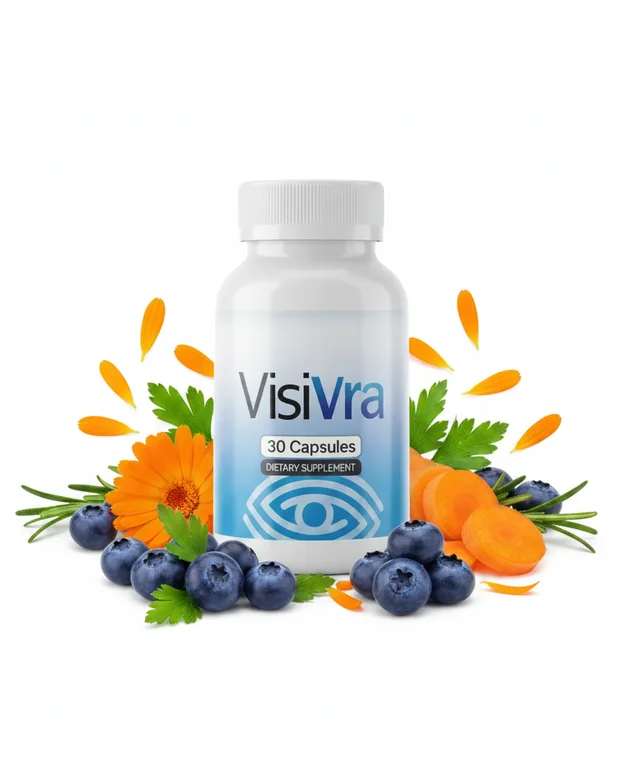
Visivra is a once-daily carotenoid capsule taken with a fat-containing meal — the pattern every trial above used. Check the label's lutein and zeaxanthin figures against the 10 mg and 2 mg reference amounts first.
Get OfferWhat will not change on any timeline
- Visual acuity. In Ma 2009, neither uncorrected nor best-spectacle-corrected visual acuity changed from baseline in either lutein arm over 12 weeks. Lutein is not a mechanism for sharpening the eye chart.
- Your spectacle prescription. Refractive error is the shape of the eye and the power of its lens. No carotenoid alters either. If you need glasses, you will still need glasses.
- Glare sensitivity, on the evidence so far. Ma 2009 found no significant change in glare sensitivity at 12 weeks. Hammond 2014 found glare disability correlated with macular pigment density but not reaching significance in the treated group even after a year. Photostress recovery did improve — two different measurements that most articles merge.
- Anything at all, if you take it inconsistently. Every trial dosed daily. There is no evidence base for occasional use.
Four things that change your personal timeline
The published windows are averages from small, mostly young, mostly healthy samples. Four factors plausibly shift where you land inside them.
Whether you take it with fat
Lutein is fat-soluble and needs dietary fat for absorption in the gut. Taking a capsule with black coffee is not the same experiment as taking it with breakfast. This is why the label says to take it with a meal, and it is the easiest variable to get wrong — the absorption trials behind that instruction are in taking eye supplements with food.
Your starting MPOD
People who begin with low macular pigment tend to show the largest increases, simply because there is more room to move. Someone already eating a great deal of kale, spinach and egg yolk has less headroom.
Dose
The 2016 meta-analysis found roughly 0.004 to 0.005 ODU per additional milligram per day, with doses above 10 mg/day and durations of 12 months or longer producing the larger increases. It also found greater MPOD increases in trials whose formula included meso-zeaxanthin — see our breakdown of how lutein, zeaxanthin and meso-zeaxanthin differ for why that third carotenoid matters. Pushing the dose higher is not a free way to shorten the timeline, and the limits that come with the rest of an AREDS-style formula are set out in eye supplement side effects.
Form
Free lutein versus lutein esters is heavily marketed as a bioavailability difference. The 2024 crossover trial tested exactly that at 6 mg/day and found no difference in serum response between the forms at any timepoint. Do not pay a premium for a faster timeline on this basis.
What the evidence does not show
The samples are small and young. Ma 2009 enrolled 37 people aged 22 to 30. Landrum 1997 enrolled two. Hammond 2014 is the only trial here above 100 participants, and it too used "young, healthy subjects". The people most likely to buy a lutein supplement — adults over 45 worried about night driving and screen fatigue — are underrepresented in the timeline evidence.
Rising MPOD has not been shown to mean better eyesight. MPOD is a mechanism marker. The two functional findings that reached significance were contrast sensitivity and photostress recovery, both measured under controlled laboratory conditions.
No trial has tested a finished multi-ingredient product on this timeline. Everything above used isolated lutein, or lutein plus zeaxanthin, at known milligram amounts. No timeline evidence exists for Visivra or any comparable branded formula as a finished product. We do not publish a milligram figure for Visivra anywhere on this site, because we have not verified one from the manufacturer's panel — read the Supplement Facts on the bottle and compare it yourself.
None of this concerns eye disease. Nothing here describes treating, preventing or slowing any condition. If your vision has changed — distortion, floaters, flashes or a dark patch — that is an appointment with an eye-care professional, not a supplement question. For what these carotenoids do and do not do, see our review of the evidence on lutein and zeaxanthin for eye health, and our full breakdown of what Visivra contains.
Medical note: this article is general information about published research, not medical advice. Dietary supplements are not intended to diagnose, treat, cure or prevent any disease. Speak to a qualified healthcare professional before starting any supplement, particularly if you smoke, have recently quit, are pregnant or nursing, or take prescription medication.
Frequently asked questions
How long does lutein take to work?
Three endpoints move on three different clocks. Serum lutein plateaus at about day 15. Macular pigment optical density starts rising roughly 20 to 40 days in and keeps climbing for months. Measurable changes in visual performance such as contrast sensitivity appeared at 12 weeks in one small trial and at 12 months in a larger one. Eight to 12 weeks is the honest minimum before judging anything.
Why did nothing happen after three weeks of lutein?
Because three weeks sits inside the loading phase. In the trial data, blood levels have already plateaued by then but macular pigment has barely started to move. Landrum and colleagues recorded the rise beginning 20 to 40 days after supplementation started, so nothing measurable at three weeks is the expected result rather than a failure.
What is macular pigment optical density?
Macular pigment optical density, or MPOD, is a measure of how much yellow carotenoid pigment sits at the centre of the retina. It is reported in optical density units and is usually measured with heterochromatic flicker photometry. It is the endpoint most lutein trials track, because it responds to intake in a way that visual acuity does not.
Does lutein improve visual acuity?
No. In the 12 week trial by Ma and colleagues, uncorrected and best spectacle corrected visual acuity did not change in either lutein arm. Lutein does not correct refractive error and will not reduce a spectacle prescription, no matter how long it is taken.
Does a higher lutein dose work faster?
The pooled data point to more rather than faster. A 2016 meta analysis of 20 randomised trials found each additional 1 mg per day was associated with roughly a 0.004 to 0.005 optical density unit increase in macular pigment, with larger increases in trials running 12 months or longer. Dose appears to shift the size of the endpoint more than the speed at which it arrives.
Scientific references
- Olmedilla-Alonso B, Granado-Lorencio F, Castro-Feito J, et al. Bioavailability of lutein from marigold flowers (free vs. ester forms): a randomised cross-over study to assess serum response and visual contrast threshold in adults. Nutrients. 2024;16(10):1415. PMID 38794653
- Landrum JT, Bone RA, Joa H, Kilburn MD, Moore LL, Sprague KE. A one year study of the macular pigment: the effect of 140 days of a lutein supplement. Exp Eye Res. 1997;65(1):57–62. PMID 9237865
- Ma L, Lin XM, Zou ZY, Xu XR, Li Y, Xu R. A 12-week lutein supplementation improves visual function in Chinese people with long-term computer display light exposure. Br J Nutr. 2009;102(2):186–90. PMID 19586568
- Hammond BR, Fletcher LM, Roos F, Wittwer J, Schalch W. A double-blind, placebo-controlled study on the effects of lutein and zeaxanthin on photostress recovery, glare disability, and chromatic contrast. Invest Ophthalmol Vis Sci. 2014;55(12):8583–9. PMID 25468896
- Ma L, Liu R, Du JH, Liu T, Wu SS, Liu XH. Lutein, zeaxanthin and meso-zeaxanthin supplementation associated with macular pigment optical density. Nutrients. 2016;8(7):426. PMID 27420092
- Age-Related Eye Disease Study 2 Research Group. Lutein + zeaxanthin and omega-3 fatty acids for age-related macular degeneration: the AREDS2 randomized clinical trial. JAMA. 2013;309(19):2005–15. PMID 23644932
- National Eye Institute — Age-Related Eye Disease Studies (AREDS/AREDS2)
Ready to run the 8 to 12 week window?
Lutein, zeaxanthin, bilberry, beta-carotene, zinc and antioxidant vitamins in one daily capsule, sold through the official store with a 60-day money-back guarantee.
Get Offer