Astaxanthin for Eye Fatigue: What the Trials Actually Show
Quick Answer: Does Astaxanthin Help With Eye Fatigue?
In several small Japanese trials, 4 to 12 mg of astaxanthin a day for about four weeks modestly improved accommodation (near-to-far focusing) and lowered self-reported eye-strain scores in screen workers. The studies are short, small and often industry-funded, so treat astaxanthin as promising for tired eyes, not proven. It does not build macular pigment the way lutein does.
- Doses studied: 4–12 mg/day, with roughly 6 mg the most common amount.
- What moved: accommodative amplitude and subjective asthenopia (eye-strain) scores, usually over four weeks.
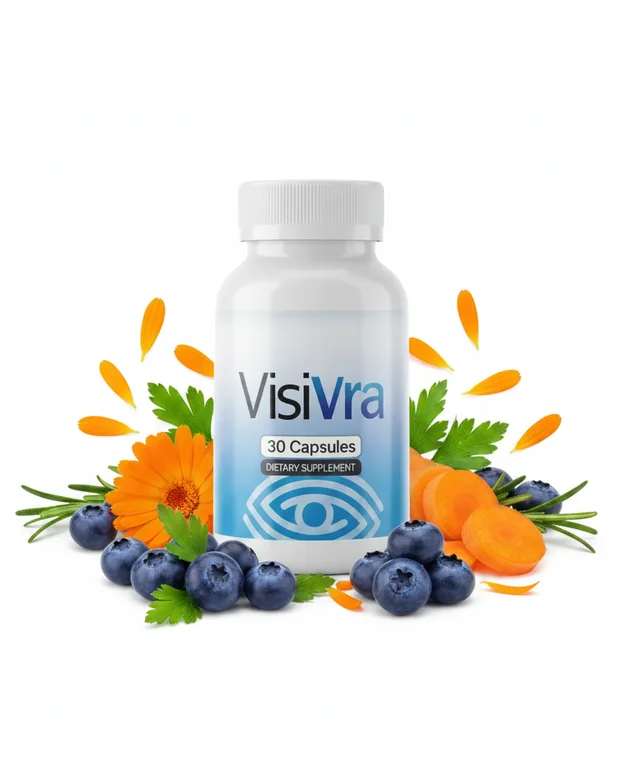
- What it is not: a macular-pigment carotenoid — that is lutein and zeaxanthin's job, and astaxanthin is not in Visivra.
Why astaxanthin keeps coming up for tired eyes
Astaxanthin is the reddish-pink pigment that gives salmon, trout and shrimp their colour. It is a carotenoid — the same broad family as lutein, zeaxanthin and beta-carotene — and specifically a xanthophyll, meaning an oxygen-containing carotenoid. Most of the supplement supply comes from a microalga, Haematococcus pluvialis, which manufactures astaxanthin as a stress shield against sunlight and drought.
Its reputation for eye fatigue does not come from marketing alone. There is a genuine cluster of Japanese clinical work, mostly from the early 2000s, that tested astaxanthin in people who use visual display terminals — office and computer workers — and reported improvements in focusing and in how strained their eyes felt. That evidence is real, but it is smaller, shorter and more commercially entangled than the headlines suggest. This article walks through what those trials measured, what they found, and where astaxanthin genuinely differs from the carotenoids in a macular formula like Visivra.
The screen-worker trials, and what they actually measured
The most-cited work is a series of small randomised, placebo-controlled studies in visual display terminal (VDT) workers. Nagaki and colleagues gave computer users around 5 to 6 mg of astaxanthin a day for four weeks and reported an improvement in accommodative amplitude — the eye's ability to shift focus from far to near — alongside a drop in subjective symptoms such as eye heaviness, soreness and blurring. A follow-up study extended the observation to accommodation and asthenopia (the clinical word for eye-strain), again over roughly four weeks.
Three things are worth pulling out of that literature:
- The dose range is narrow. Eye-focused trials clustered between 4 and 12 mg per day, with 6 mg the workhorse dose. Larger amounts appear in studies of general or muscular fatigue, not the eyes.
- The timescale is short. Four weeks is typical; a handful ran to six. Nobody in this set followed people for the months it takes to judge a macular carotenoid.
- The endpoints are focusing and feelings. Accommodative amplitude and critical flicker fusion are objective-ish measures of the focusing system and visual processing speed; the eye-strain scores are self-reported questionnaires. None of these is a measure of retinal pigment or of long-term eye health.
A 2020 review in Marine Drugs pulled this body of work together and reached a measured conclusion: astaxanthin shows promise for accommodation and asthenopia, but the trials are small, heterogeneous in design, and frequently funded by companies with a commercial interest in the ingredient. That is the honest state of play.
Why "accommodation" is the key word
Accommodation is what your eye does when you look up from a spreadsheet to a colleague across the room and everything snaps back into focus. A ring of muscle called the ciliary body changes the shape of the lens to do it. Stare at a screen at a fixed distance for hours and that system fatigues, which is a large part of what "digital eye strain" feels like.
The proposed mechanism for astaxanthin here is not about the retina at all. It is about the ciliary muscle and blood flow — astaxanthin is a potent antioxidant and there is some evidence it supports microcirculation, which is the rationale offered for a tired focusing system recovering a little faster. That is a plausible, mechanistically distinct story from the macular-pigment one, and it is important to keep the two separate. When a product blurs "astaxanthin helps eye fatigue" into "astaxanthin protects your eyes as you age," it has quietly swapped one claim for a much bigger, unsupported one.
Astaxanthin versus lutein: different carotenoids, different jobs
This is the single most important distinction in the whole topic, and it is where a lot of supplement copy gets sloppy.
Lutein and zeaxanthin are selectively pulled out of the bloodstream and deposited in the central retina, where they form the macular pigment — a yellow filter that absorbs high-energy blue light before it reaches the photoreceptors. This is the mechanism behind the AREDS2 formula and the large body of macular-pigment research. You can literally measure the pigment building up over months.
Astaxanthin is not concentrated in the macula in any meaningful way in humans. It circulates as a general antioxidant. So while it belongs to the same chemical family, it does a different job and is studied against different endpoints. It does not build macular pigment, and the eye-fatigue trials never claimed it did.
The one-line version of each carotenoid
Lutein & zeaxanthin: deposited in the macula, build the blue-light-filtering pigment, measured over months. This is Visivra's core.
Astaxanthin: circulating antioxidant, studied for the focusing muscle and eye-strain scores over about four weeks. Not in Visivra.
Beta-carotene: a provitamin A carotenoid the retina needs for the light-sensing cycle — a different role again.

Visivra is built on the macular carotenoids
Visivra pairs lutein and zeaxanthin with bilberry, beta-carotene, zinc and antioxidant vitamins C and E. It does not contain astaxanthin — and we would rather say so than pretend otherwise. Read the Supplement Facts panel before you buy.
Get OfferThe honest limitations
If you take away one thing, make it this: the astaxanthin eye-fatigue evidence is promising but thin. The reasons are worth naming plainly.
- Small samples. Most trials enrolled a few dozen people. Small studies produce noisy, easily overstated results, and effects tend to shrink when larger studies are eventually run.
- Short duration. Four weeks tells you about a transient effect on tired muscles, not about anything sustained.
- Funding and publication. A meaningful share of the work is tied to companies that sell astaxanthin, and several key papers appear in specialist or non-English journals that are harder to scrutinise. That does not make the results wrong, but it lowers the confidence you should place in them.
- Mixed endpoints. Some trials leaned on subjective questionnaires; the objective focusing measures did not always move in lockstep with how people said they felt.
None of this is a reason to dismiss astaxanthin. It is a reason to keep the claim modest: a possible, short-term easing of screen-related eye strain, not a vision upgrade.
What astaxanthin will not do
- It will not build macular pigment. That is lutein, zeaxanthin and meso-zeaxanthin. If macular support is your goal, astaxanthin is the wrong tool.
- It will not sharpen your eyesight or change your prescription. Focusing fatigue and refractive error are different things; no carotenoid corrects the latter.
- It will not treat, prevent or cure any eye condition. The trials measured comfort and focusing in healthy screen users, nothing more.
- It will not fix a workstation problem. If your eyes ache by mid-afternoon, screen distance, brightness, blink rate and breaks matter far more than any capsule.
Where this leaves Visivra
We will be straight, because that is the whole point of this blog: Visivra does not contain astaxanthin. Its formula is the AREDS-style, macular-pigment approach — lutein and zeaxanthin at its centre, with bilberry, beta-carotene, zinc and vitamins C and E around them. That is a deliberate, evidence-led choice: the carotenoids with the strongest, longest human record for the retina are the ones on the label. If your interest is specifically short-term screen-fatigue easing, astaxanthin is a separate ingredient you would source separately, and you should weigh it on the modest evidence above rather than on marketing. For the day-to-day realities of long screen sessions, see our piece on eye supplements and screen time, and our overview of the nutrients Visivra actually contains.
Medical note: this article is general information about published research, not medical advice. Dietary supplements are not intended to diagnose, treat, cure or prevent any disease. Persistent eye strain, headaches or changes in vision are reasons to see an eye-care professional, not to add another capsule. Speak to a qualified healthcare professional before starting any supplement.
Related reading
- Saffron and Macular Function: What the Evidence Says
- Meso-Zeaxanthin: The Third Macular Carotenoid
- Why You Should Take Eye Supplements With Food
- Contrast Sensitivity, Explained for Vision
Frequently asked questions
How much astaxanthin was used in eye-fatigue studies?
Most of the Japanese trials used between 4 and 12 mg of astaxanthin a day, with 6 mg the most common dose. Studies typically ran for four to six weeks. Higher doses were tested for general physical fatigue rather than the eyes, and there is no established eye dose because the trials were small and not standardised.
Is astaxanthin the same as lutein and zeaxanthin?
No. All three are carotenoids, but they behave differently in the eye. Lutein and zeaxanthin are selectively deposited in the macula, where they build the macular pigment that filters blue light. Astaxanthin is not stored there in any meaningful amount; it acts as a general antioxidant and is studied mainly for the focusing muscle, not macular pigment.
How long before astaxanthin affects eye fatigue?
In the trials that reported a change, effects on accommodation and eye-strain scores were measured after about four weeks of daily use. Nothing in this literature suggests a same-day or single-dose effect, and the studies were too short to say what happens beyond a couple of months of use.
Can astaxanthin replace taking breaks from screens?
No. No supplement replaces the basics of screen comfort: regular breaks, the 20-20-20 habit, correct screen distance, decent lighting and remembering to blink. Astaxanthin was tested as an addition to normal working conditions, not as a substitute for them, and the measured effects were modest.
Scientific references
- Giannaccare G, Pellegrini M, Senni C, et al. Clinical applications of astaxanthin in the treatment of ocular diseases: emerging insights. Mar Drugs. 2020;18(5):239. PMID 32370045
- Nagaki Y, Hayasaka S, Yamada T, et al. Effects of astaxanthin on accommodation, critical flicker fusion, and pattern visual evoked potential in visual display terminal workers. J Trad Med. 2002;19(5):170–173. (Small VDT-worker RCT; no PubMed index.)
- Nagaki Y, Mihara M, Tsukahara H, Ono S. The supplementation effect of astaxanthin on accommodation and asthenopia. J Clin Ther Med. 2006;22(1):41–54. (Accommodation and eye-strain endpoints; no PubMed index.)
- Ma L, Liu R, Du JH, Liu T, Wu SS, Liu XH. Lutein, zeaxanthin and meso-zeaxanthin supplementation associated with macular pigment optical density. Nutrients. 2016;8(7):426. PMID 27420092
- Age-Related Eye Disease Study 2 Research Group. Lutein + zeaxanthin and omega-3 fatty acids for age-related macular degeneration: the AREDS2 randomized clinical trial. JAMA. 2013;309(19):2005–15. PMID 23644932
Prefer the macular-carotenoid route?
Lutein, zeaxanthin, bilberry, beta-carotene, zinc and antioxidant vitamins in one daily capsule, sold through the official store with a 60-day money-back guarantee.
Get Offer