Eye Supplements and Screen Time: What Carotenoids Can and Cannot Do About Digital Eye Strain
Quick Answer: Do Eye Supplements Help With Screen Time?
Only for one part of the problem — the carotenoid trials measured contrast sensitivity and recovery from bright light, not the dryness and focusing fatigue that most screen users actually complain about, and breaks, blinking and screen distance do more for those than any capsule. Exactly one published trial has enrolled long-term computer users and given them lutein: 37 people, 12 weeks, contrast sensitivity improved and visual acuity did not.
- Dryness and grit: caused by reduced blinking. No carotenoid trial has ever measured it.
- Focusing fatigue: screens behave like print here. No carotenoid mechanism exists.
- Contrast and light recovery: the only part that has been measured, and it moved.
- Highest-yield change: scheduled breaks. Tested in screen users; symptoms returned when the prompts stopped.
Screen discomfort is two different problems wearing one name
"Digital eye strain" is a bag of symptoms, not a single mechanism. Mark Rosenfield's 2011 review in Ophthalmic & Physiological Optics put the prevalence at between 64% and 90% of computer users reporting visual symptoms, and separated the plausible causes into two families: oculomotor issues and dry eye.
That split matters enormously for the supplement question, because carotenoids act in one place only — the macula, at the back of the eye. Nothing lutein or zeaxanthin does can reach the tear film. So before asking whether a capsule helps, work out which of your symptoms is which.
| Symptom | Underlying cause | Does a carotenoid address it? | What the evidence is |
|---|---|---|---|
| Dry, gritty, burning eyes | Blink rate falls during reading, and the share of incomplete blinks rises specifically on screens, leaving more corneal surface exposed | No — wrong tissue entirely | Rosenfield, Ophthalmic Physiol Opt 2011 · Argilés et al., IOVS 2015 (n=50). No carotenoid trial has used a dry-eye sign as an endpoint |
| Focusing fatigue after long sessions | Sustained near accommodation and vergence demand | No — no proposed mechanism | Rosenfield 2011: accommodation and vergence responses to screens are similar to those found with printed material |
| Contrast fading, text washing out | Macular pigment density is correlated with contrast performance; it is built from dietary carotenoids | Measured, and it moved | Ma et al., Br J Nutr 2009;102(2):186–90 (n=37, 12 weeks) · PMID 19586568 |
| Slow recovery after a bright screen or window | Photostress recovery — how fast the retina re-acquires detail after intense light | Measured, and it moved | Hammond et al., IOVS 2014;55(12):8583–9 (n=115, 12 months) · PMID 25468896 |
| Headache, neck and shoulder ache | Monitor height, posture, lighting, and uncorrected refractive error | No — ergonomic and optical, not nutritional | Self-reported headache frequency did fall in one 6-month carotenoid trial (Stringham 2017, n=48), but that is a questionnaire result, not a mechanism |
Read the table as a filter. If your main complaint is in rows 1, 2 or 5, the evidence for a capsule is absent or extremely thin, and the fixes are behavioural. If it is rows 3 or 4, there is something to talk about.
The one trial that actually enrolled screen users
Almost every article on this topic lists lutein without naming a study. There is a study, and it is worth reporting in full, including the parts that did not work.
Ma and colleagues recruited 37 healthy adults aged 22 to 30 with long-term computer display light exposure and randomly assigned them to three groups: 6 mg lutein per day (n=12), 12 mg lutein per day (n=13), or a maltodextrin placebo (n=12). Serum lutein and visual performance were measured at week 0 and week 12.
What happened over 12 weeks:
- Serum lutein rose in both active arms — from 0.356 to 0.607 µmol/L at 6 mg, and from 0.328 to 0.733 µmol/L at 12 mg.
- Contrast sensitivity increased in both lutein groups, reaching statistical significance at most visual angles in the 12 mg arm.
- Uncorrected and best-spectacle-corrected visual acuity did not change. The authors noted only a non-significant trend in the 12 mg group.
- Glare sensitivity did not change over the 12 weeks.
Now the limitation, in the same breath rather than buried at the bottom: this is roughly a dozen people per arm, all aged 22 to 30, all healthy, in a single centre. It is also the strongest directly on-point evidence that exists, which tells you how thin this field is. And note what "improves visual function" meant — a laboratory contrast measurement changed. Whether anyone felt more comfortable at their desk was not measured.
What "blue light" actually justifies, and what it does not
The mechanism marketed alongside every screen-time supplement is blue-light filtering: macular pigment absorbs short-wavelength light, so a denser pigment layer intercepts more of it before it reaches the photoreceptors. The optics are not in dispute. Whether it translates into anything you would notice at work is.
Blue-light filtering as an intervention has been tested and mostly failed. A 2023 Cochrane review of 17 randomised trials found blue-light filtering spectacle lenses probably make little or no difference to short-term eye strain from computer work, and that the evidence was too uncertain to say anything about contrast sensitivity, colour discrimination, glare or macular health. The American Academy of Ophthalmology does not recommend blue-light-blocking eyewear for computer use, and states there is no scientific evidence that screen light damages the eye. A lens in front of the eye is not the same experiment as pigment inside the retina — but it is a warning about the reasoning. "This filters blue light" has already failed to predict "this reduces eye strain" once, across seventeen trials.
One trial has tested carotenoids specifically against screen-time symptoms. Stringham and colleagues gave 48 healthy young adults with at least six hours of daily near-field screen exposure either 24 mg per day of combined macular carotenoids or placebo for six months. Macular pigment density rose, and participants reported less eye strain, less eye fatigue, fewer headaches and better sleep, alongside gains on the laboratory visual measures. Three caveats belong with it, and the pages that cite it omit all three: the symptom outcomes were self-reported on questionnaires, the sample was 48 people, and 24 mg a day is roughly double the 10 mg lutein plus 2 mg zeaxanthin reference amount. One study is where an evidence base starts, not where it ends.
The two-tissue rule
Front of the eye — tear film, cornea, blink mechanics. This is where dryness, grit and burning come from. Nothing you swallow as a carotenoid reaches it. Fixed by blinking, breaks, humidity and lubricating drops if an eye-care professional recommends them.
Back of the eye — the macula and its yellow pigment layer. This is where lutein and zeaxanthin end up, and where contrast and light-recovery measurements come from.
If you cannot say which of the two your symptom belongs to, you cannot judge whether a supplement is even the right category of answer.
Screen-heavy and dose-checking the label?
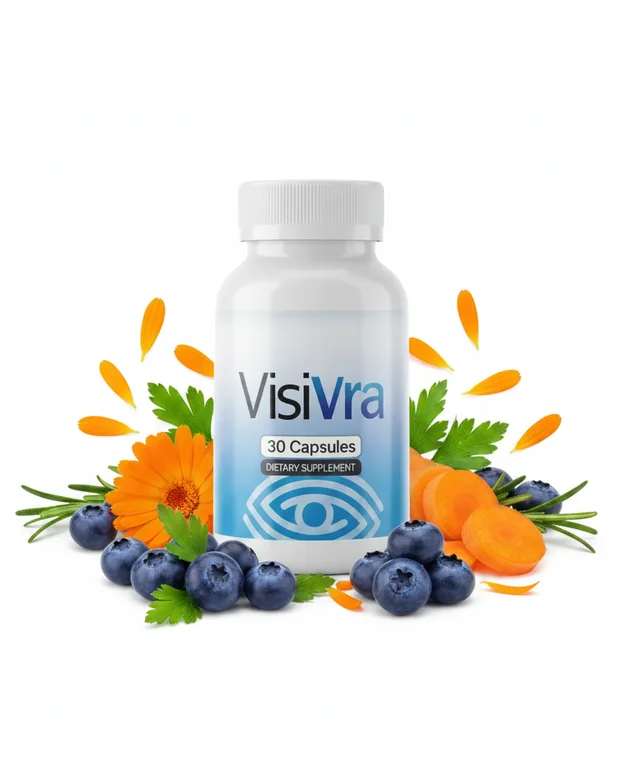
Visivra is a once-daily carotenoid capsule taken with a fat-containing meal. We do not publish a milligram figure for it — read the Supplement Facts panel and compare its lutein and zeaxanthin numbers against the 10 mg and 2 mg reference amounts yourself.
Get OfferThe larger trial, and why it is only half relevant here
The best-powered study in this literature is Hammond and colleagues' 2014 trial: 115 young healthy adults, 57 on 10 mg lutein plus 2 mg zeaxanthin and 58 on placebo, for a full year. Macular pigment density rose significantly against placebo at every eccentricity measured. Chromatic contrast improved significantly. Photostress recovery time — how long vision takes to come back after a 30-second intense flash — improved significantly. Glare disability correlated with pigment density throughout but did not increase significantly in the treated group.
Real, well-measured results — and not a screen-time trial. Nobody was recruited for screen exposure, no screen-comfort endpoint was collected, and it took twelve months. We cover the photostress and glare findings, including what a photostress test involves and why "mesopic" conditions matter, in our piece on lutein, glare recovery and night driving rather than repeating the table here. The honest read: a year of the reference dose changes how the retina handles light. It does not tell you your afternoon at a monitor will feel different.
What to do first, because it outperforms the capsule
Take breaks, and expect them to stop working when you stop
Talens-Estarelles and colleagues tested the 20-20-20 rule directly — every 20 minutes, look at something 20 feet away for 20 seconds — in 29 symptomatic computer users, using software that watched break-taking, gaze and blinking through the laptop webcam and issued personalised reminders. Over two weeks, digital eye strain symptoms and dry eye symptoms both improved. Binocular vision measures largely did not, and dry-eye signs did not. Most instructively, the symptom improvements were not maintained one week after the reminders stopped. Breaks are a habit, not a cure, and they need a prompt to survive.
Blink deliberately, and blink fully
Argilés and colleagues recorded 50 people with healthy eyes across six controlled reading conditions plus a baseline of looking at a picture two metres away. Every reading condition dropped the blink rate. But the finding that separates screens from paper was different: the share of incomplete blinks rose specifically during electronic reading, not with hard copy. Partial blinks leave the lower cornea exposed. Closing the lids all the way, deliberately, several times, is free.
Fix distance, height and lighting before nutrition
Rosenfield's review flags monitor position in primary gaze — straight ahead rather than below eye level — as a contributor to corneal exposure, and notes that uncorrected refractive error remains a common and overlooked driver of symptoms. If you have not had an eye examination recently, that hour beats any supplement decision. A slightly wrong prescription will ruin an afternoon faster than a missing carotenoid.
What the evidence does not show
No trial has shown a carotenoid improving a dry-eye sign. Not tear break-up time, not osmolarity, not staining. The Stringham questionnaires are the closest anything comes, and self-reported scores are the weakest endpoint class in the set. Anyone telling you lutein relieves screen dryness is extrapolating past the data.
The samples are small and young. Ma 2009 enrolled 37 people aged 22 to 30. Stringham 2017 enrolled 48 young adults. Hammond 2014 enrolled 115, also young and healthy. The 45-year-old with fifteen years of desk work behind them — the person most likely to be reading this — is barely represented anywhere in this literature.
Nothing here is fast. The shortest trial ran 12 weeks. Blood lutein plateaus in about a fortnight but retinal pigment takes months to shift; we walk through that mismatch in how long lutein takes to work. If you want something to make this evening easier, a supplement is the wrong tool by an order of magnitude.
No finished multi-ingredient product has been tested on any of these endpoints. Every trial above used isolated lutein, or lutein plus zeaxanthin, at known milligram amounts. A commercial capsule containing several ingredients is not the tested intervention — that applies to Visivra as much as to any competitor, and we do not publish a milligram figure for it because we have not verified one from the manufacturer's panel. For what these two carotenoids do and do not do, see our review of the evidence on lutein and zeaxanthin for eye health, or our full breakdown of what Visivra contains. And none of this is about eye disease: screen use has not been shown to cause lasting damage to the eye, and blurred vision that does not settle is a reason to book an eye examination, not to buy a supplement.
Medical note: this article is general information about published research, not medical advice. Dietary supplements are not intended to diagnose, treat, cure or prevent any disease. Speak to a qualified healthcare professional before starting any supplement, particularly if you smoke, have recently quit, are pregnant or nursing, or take prescription medication.
Frequently asked questions
Do eye supplements help with screen time?
Only for one part of it. The carotenoid trials measured contrast sensitivity and recovery from a bright flash, and those did move. Dryness, grittiness and focusing fatigue, which are what most screen users actually report, have not been shown to respond to lutein or zeaxanthin. One small placebo controlled trial in high screen time users reported lower self rated eye strain after six months at 24 mg a day, but that is a single questionnaire based result in 48 people.
Do lutein supplements help with dry eyes from screens?
No trial has shown that. Screen related dryness is driven by a lower blink rate and a higher proportion of incomplete blinks during reading, which is an ocular surface issue rather than a retinal one. No carotenoid trial has used a dry eye sign such as tear break up time as an endpoint, so there is nothing to point to.
Is there any trial of lutein in people who use screens all day?
Yes, one. Ma and colleagues enrolled 37 healthy Chinese adults aged 22 to 30 with long term computer display exposure and gave them 6 mg lutein, 12 mg lutein or a maltodextrin placebo for 12 weeks. Contrast sensitivity rose in both lutein groups and reached significance at most visual angles in the 12 mg group. Visual acuity and glare sensitivity did not change. It is the only trial of its kind and it had about a dozen people per arm.
Do blue light blocking glasses or blue light supplements work?
A 2023 Cochrane review of 17 randomised trials found blue light filtering spectacle lenses probably make little or no difference to short term eye strain from computer work, and the American Academy of Ophthalmology does not recommend them. Blue light filtering supplements are a separate question with a separate and much thinner evidence base, and no trial has compared a carotenoid capsule against a blue light lens.
What actually helps most with screen related eye discomfort?
Behaviour and setup, on the current evidence. A study of 29 symptomatic computer users found that prompted breaks following the 20 20 20 rule improved self reported eye strain and dry eye symptoms over two weeks, and that the improvement disappeared within a week of the prompts stopping. Breaks, blink awareness, screen distance and room lighting are the higher yield changes. A capsule is not a substitute for any of them.
Scientific references
- Ma L, Lin XM, Zou ZY, Xu XR, Li Y, Xu R. A 12-week lutein supplementation improves visual function in Chinese people with long-term computer display light exposure. Br J Nutr. 2009;102(2):186–90. PMID 19586568
- Hammond BR, Fletcher LM, Roos F, Wittwer J, Schalch W. A double-blind, placebo-controlled study on the effects of lutein and zeaxanthin on photostress recovery, glare disability, and chromatic contrast. Invest Ophthalmol Vis Sci. 2014;55(12):8583–9. PMID 25468896
- Stringham JM, Stringham NT, O'Brien KJ. Macular carotenoid supplementation improves visual performance, sleep quality, and adverse physical symptoms in those with high screen time exposure. Foods. 2017;6(7):47. PMID 28661438
- Rosenfield M. Computer vision syndrome: a review of ocular causes and potential treatments. Ophthalmic Physiol Opt. 2011;31(5):502–15. PMID 21480937
- Argilés M, Cardona G, Pérez-Cabré E, Rodríguez M. Blink rate and incomplete blinks in six different controlled hard-copy and electronic reading conditions. Invest Ophthalmol Vis Sci. 2015;56(11):6679–85. PMID 26517404
- Talens-Estarelles C, Cerviño A, García-Lázaro S, Fogelton A, Sheppard A, Wolffsohn JS. The effects of breaks on digital eye strain, dry eye and binocular vision: testing the 20-20-20 rule. Cont Lens Anterior Eye. 2023;46(2):101744. PMID 35963776
- Singh S, Downie LE, Anderson AJ, et al. Blue-light filtering spectacle lenses for visual performance, sleep, and macular health in adults. Cochrane Database Syst Rev. 2023;8:CD013244. PMID 37593770
- American Academy of Ophthalmology — Should You Be Worried About Blue Light?
If you want to run the 12-week window yourself
Lutein, zeaxanthin, bilberry, beta-carotene, zinc and antioxidant vitamins in one daily capsule, sold through the official store with a 60-day money-back guarantee. Fix the breaks and the screen setup first.
Get Offer