Meso-Zeaxanthin: The Third Macular Carotenoid Explained
Quick Answer: What Is Meso-Zeaxanthin?
Meso-zeaxanthin is the third carotenoid that, with lutein and zeaxanthin, builds the macular pigment at the back of your eye. It sits most densely at the very centre of the macula, is almost absent from food, and appears to be made inside the retina from lutein. Most trials show carotenoid supplements can raise macular pigment density.
- Position: it dominates the dead centre of the macula, the fovea, where vision is sharpest.
- Diet: it has no meaningful food source — the retina makes it from the lutein you eat.
- Evidence: pooled trials link carotenoid supplements, including meso-zeaxanthin, to a rise in macular pigment optical density.
Ask most people to name the nutrients in an eye-support supplement and you will hear "lutein" and, if they read labels, "zeaxanthin." Almost nobody mentions the third member of the family. Yet meso-zeaxanthin is arguably the most interesting of the trio, because it is the one your eye appears to manufacture itself, in the exact spot where you do your finest seeing. This article walks through what it is, where it sits, why it is missing from your plate, and what the research actually supports — without wandering into claims about disease.
The macular pigment is made of three carotenoids, not one
At the centre of your retina is a small yellow patch called the macula, and inside it a still smaller pit called the fovea. This is the tissue responsible for reading, recognising faces and every task that needs fine detail. Layered across it is the macular pigment: a yellow screen built from dietary carotenoids that absorbs high-energy blue light before it reaches the light-sensing cells beneath.
That pigment is not a single substance. It is a blend of three closely related molecules: lutein, zeaxanthin and meso-zeaxanthin. What makes the arrangement elegant is that the three are not thrown together at random. Each one predominates in a different zone. Lutein is the workhorse of the outer macula and increases with distance from the centre. Zeaxanthin is concentrated more centrally. And meso-zeaxanthin peaks at the very middle of the fovea and tapers off outward — the reverse of lutein's pattern.
Bone, Landrum and colleagues mapped this distribution in human retinas back in 1997, dividing the macula into concentric zones and measuring the stereoisomers in each. Their work is still the reference point for describing where each carotenoid lives, and it is where the "three-zone" picture of the macular pigment comes from.
Lutein, zeaxanthin and meso-zeaxanthin, side by side
A short comparison makes the differences concrete.
| Property | Lutein | Zeaxanthin | Meso-zeaxanthin |
|---|---|---|---|
| Where it peaks in the retina | Outer macula; rises with distance from the fovea | Central macula | The dead centre of the fovea; falls off outward |
| Main dietary source | Kale, spinach and other dark leafy greens; marigold extract in supplements | Corn, orange peppers, cooked egg yolk, goji berries | No meaningful dietary source |
| How it reaches the eye | Absorbed from food with dietary fat | Absorbed from food with dietary fat | Appears to be produced inside the retina from lutein |
| Can the body make it? | No | No | Yes — via conversion of lutein in the macula |
Distribution rows draw on Bone RA, Landrum JT, et al., Exp Eye Res 1997;64(2):211–218 (PMID 9176055), which mapped the carotenoid stereoisomers across three concentric retinal zones.
Where meso-zeaxanthin sits — and why the location matters
The single most important fact about meso-zeaxanthin is its position. It is most concentrated at the exact centre of the fovea, the point of your sharpest vision and, not coincidentally, the point exposed to the most focused, highest-energy light entering the eye. A pigment that peaks precisely there is well placed to act as a filter for the tissue that can least afford to be swamped by blue light.
This is a structural observation, not a clinical promise. Knowing that a molecule concentrates in the fovea tells you the retina sorts these carotenoids deliberately; it does not, on its own, prove that adding more of one improves how anyone sees. But it does explain why researchers who study the macular pigment treat meso-zeaxanthin as a full member of the trio rather than a curiosity, and why its distribution is so often drawn as a bell curve peaking dead centre.
It is barely a food carotenoid at all
Here is where meso-zeaxanthin parts company with its two relatives. Lutein and zeaxanthin are dietary carotenoids: you get them by eating plants and, in the case of zeaxanthin, a few animal foods such as egg yolk. Meso-zeaxanthin is different. It has no meaningful presence in an ordinary human diet.
Small amounts have been detected in a handful of unusual foods — the skin of certain fish, some shrimp and marine species that themselves metabolise carotenoids — but nothing you would eat in quantities that move the needle. For practical purposes, you cannot eat your way to a meaningful meso-zeaxanthin intake the way you can with lutein by eating greens. So how does it end up as one of the three most abundant carotenoids in your retina?
Made in the retina, from lutein
The accepted explanation, again originating with Bone and Landrum's group, is that the retina makes its own meso-zeaxanthin by converting lutein. On this model, lutein and zeaxanthin are carried into retinal tissue in roughly the proportions found in the bloodstream, and then some of the lutein is transformed into meso-zeaxanthin, mainly within the macula itself. The conversion appears less developed in infants than in adults, which fits the idea of a pathway that builds up the central pigment over time.
Two things are worth stating plainly about this. First, it is a well-supported proposal rather than a fully mapped enzymatic pathway; the exact machinery is still being characterised. Second, and more usefully for anyone reading a label, it reframes what "getting enough meso-zeaxanthin" means. If your retina makes meso-zeaxanthin out of lutein, then lutein intake is quietly feeding the central-pigment pool whether or not a supplement lists meso-zeaxanthin as a separate ingredient. Lutein turns out to be the more foundational carotenoid of the group precisely because it is the raw material for the third one.
What the trials actually show
The functional question — does raising these carotenoids do anything measurable? — has been studied mostly through a marker called macular pigment optical density, or MPOD, which estimates how much pigment sits in the macula. Across the literature, supplementing with macular carotenoids tends to raise MPOD over months of consistent use.
On meso-zeaxanthin specifically, the most cited pooled analysis is a 2016 meta-analysis by Ma and colleagues in Nutrients, which combined 20 randomised controlled trials covering people with and without age-related macular changes, at doses up to 20 mg a day over durations from eight weeks to two years. It reported a greater increase in macular pigment in trials whose supplement included meso-zeaxanthin than in those without it. Separately, trials from the Nolan group in Ireland, including the CREST study, have reported that enriching the macular pigment with formulations containing all three carotenoids can improve contrast sensitivity in people free of retinal disease.
The honest caveat is important. The 2016 finding is an observation across studies that differed in dose, duration and population — not a single randomised head-to-head that added meso-zeaxanthin to an otherwise identical formula. So the pooled data lean towards a benefit from including it, while stopping short of proving that meso-zeaxanthin does something lutein and zeaxanthin together cannot. That is the current state of the evidence, and anyone telling you otherwise is running ahead of it.
The three-sentence summary
What it is: the third macular carotenoid, peaking at the centre of the fovea.
Where it comes from: not the diet — the retina appears to make it from lutein.
What the data support: carotenoid supplementation, including meso-zeaxanthin, can raise macular pigment density over months. No disease claim follows from that.
Does a formula need all three?
This is the practical question, and the answer is more measured than the marketing on either side. Because the retina converts lutein into meso-zeaxanthin, a formula that delivers a solid lutein dose is already supplying the raw material for the central pigment. That is why many well-regarded eye formulas — including the AREDS2 study formula that so many products copy — use lutein and zeaxanthin without adding meso-zeaxanthin separately, and still see macular pigment rise.
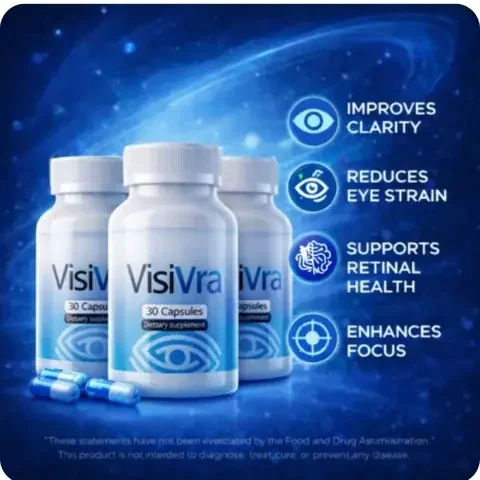
Products that add meso-zeaxanthin directly are betting that supplying the finished molecule beats relying on conversion. The pooled evidence gives that bet some support, but not a definitive result. Visivra takes the more conventional route: it pairs lutein and zeaxanthin, and leaves the meso-zeaxanthin step to your retina, alongside bilberry, beta-carotene, zinc and the antioxidant vitamins C and E. If you are comparing labels, the number that matters most is the lutein dose, because that is the carotenoid feeding all of this.
What the evidence does not show
It is not a cure or a treatment for anything. Nothing here describes preventing, treating or reversing an eye condition. Meso-zeaxanthin is a dietary carotenoid, and Visivra is a dietary supplement. Raising macular pigment is a measurable biological change; it is not the same as a clinical outcome, and it should not be read as one.
The conversion pathway is a model, not a fully mapped mechanism. "Lutein is converted to meso-zeaxanthin in the retina" is the accepted explanation for what researchers measure, but the enzymes involved are still being worked out.
No trial has isolated meso-zeaxanthin. The pooled data lean towards including it, yet the clean head-to-head comparison — the same formula with and without meso-zeaxanthin — has not been the basis of these conclusions. If your central vision changes suddenly, that is a reason to see an eye-care professional, not to compare supplement panels.
Related reading
- Saffron and macular function: what the evidence shows
- Photostress recovery and macular pigment
- Contrast sensitivity explained for vision
- Astaxanthin for eye fatigue: what the trials show
Medical note: this article is general information about published research, not medical advice. Dietary supplements are not intended to diagnose, treat, cure or prevent any disease. Speak to a qualified healthcare professional before starting any supplement, particularly if you smoke, have recently quit, are pregnant or nursing, or take prescription medication.
Frequently asked questions
What is meso-zeaxanthin and where is it found?
Meso-zeaxanthin is one of the three carotenoids that make up the macular pigment, the yellow filter layer at the centre of the retina. It is found almost entirely in the eye, where it reaches its highest concentration at the very centre of the macula, the fovea, which is the spot responsible for your sharpest, most detailed vision.
Is meso-zeaxanthin in the diet?
Barely. Unlike lutein and zeaxanthin, meso-zeaxanthin has no significant source in an ordinary diet. Trace amounts have been reported in a few foods such as some fish skin and shrimp, but not in quantities that matter nutritionally. The retina appears to make its own supply by converting the lutein you eat.
How does meso-zeaxanthin differ from zeaxanthin?
They are stereoisomers, meaning the same molecule mirrored at one carbon. Dietary zeaxanthin arrives ready-made from food such as corn, orange peppers and egg yolk, while meso-zeaxanthin is produced inside the retina from lutein. The two also occupy slightly different zones, with meso-zeaxanthin most concentrated at the dead centre of the macula.
Does a formula need all three carotenoids?
Not necessarily. Because the retina can make meso-zeaxanthin from lutein, a formula that supplies enough lutein is already feeding that pathway indirectly. Some products add meso-zeaxanthin directly, and pooled trial data lean towards a larger rise in macular pigment when it is included, but no single trial has isolated it against lutein and zeaxanthin alone.
Scientific references
- Bone RA, Landrum JT, Friedes LM, et al. Distribution of lutein and zeaxanthin stereoisomers in the human retina. Exp Eye Res. 1997;64(2):211–218. PMID 9176055
- Ma L, Liu R, Du JH, Liu T, Wu SS, Liu XH. Lutein, zeaxanthin and meso-zeaxanthin supplementation associated with macular pigment optical density: a systematic review and meta-analysis. Nutrients. 2016;8(7):426. PMID 27420092
- Nolan JM, Power R, Stringham J, et al. Enrichment of macular pigment enhances contrast sensitivity in subjects free of retinal disease: CREST report 1. Invest Ophthalmol Vis Sci. 2016;57(7):3429–3439. PMID 27367585
- Age-Related Eye Disease Study 2 Research Group. Lutein + zeaxanthin and omega-3 fatty acids for age-related macular degeneration: the AREDS2 randomized clinical trial. JAMA. 2013;309(19):2005–15. PMID 23644932
- Li X, Holt RR, Keen CL, et al. Potential roles of dietary zeaxanthin and lutein in macular health and function. Nutr Rev. 2023;81(6):670–683. doi:10.1093/nutrit/nuac076
- National Eye Institute — Age-Related Eye Disease Studies (AREDS/AREDS2)
Feed the pathway with lutein and zeaxanthin
Visivra pairs lutein and zeaxanthin — the carotenoids your retina uses to build the macular pigment, meso-zeaxanthin included — with bilberry, beta-carotene, zinc and antioxidant vitamins C and E, sold through the official store with a 60-day money-back guarantee.
Get Offer