How to Read an Eye Supplement Label: The Six Numbers Worth Checking
Quick Answer: What Should You Check on an Eye Supplement Label?
Six numbers and one phrase — the milligrams of lutein, zeaxanthin, vitamin C, vitamin E, zinc and copper, and whether the words "proprietary blend" appear anywhere on the panel. Compare the six figures against what the AREDS2 trial actually used (10 mg lutein, 2 mg zeaxanthin, 500 mg vitamin C, 400 IU vitamin E, 80 mg zinc, 2 mg copper). If the panel hides those amounts inside a blend weight, there is nothing to compare and the comparison is over before it starts.
- The reference set: AREDS2, JAMA 2013;309(19):2005-15 — trial amounts, not a legal standard.
- The one disqualifier: a blend weight with no per-ingredient milligrams.
- The overlooked one: copper, which belongs next to a high zinc figure.
Almost every buying guide for eye supplements tells you to "compare the milligrams" and then never says what to compare them against. That advice is unusable. This page gives you the reference column, the arithmetic that exposes a proprietary blend, and the two label distinctions — free lutein versus lutein esters, and zinc without copper — that change what a stated number actually means. Everything below describes what published trials contained and what US labelling rules require; none of it says a given amount will do anything for your eyes. For what the carotenoid evidence does and does not support, see our review of lutein and zeaxanthin for eye health.
The six numbers, and the column to check them against
The reference amounts below come from one place: the Age-Related Eye Disease Study 2, published in JAMA in 2013. That trial gave 10 mg of lutein and 2 mg of zeaxanthin on top of the original AREDS base of 500 mg vitamin C, 400 IU vitamin E, 80 mg zinc and 2 mg copper as cupric oxide, and it dropped the 15 mg of beta-carotene the first formula had carried.
Two warnings. These are trial amounts, not requirements — there is no legal standard for an eye supplement, and a product below these figures is not thereby defective. And AREDS2 enrolled people who already had intermediate macular changes, so the numbers are a yardstick for comparison, not a prescription, and were never tested in healthy eyes.
Reference table: what to check, and what a red flag looks like
| Nutrient | AREDS2 trial amount | What the label should say | Red flag |
|---|---|---|---|
| Lutein | 10 mg/day | A milligram figure on its own line, with an asterisk in the %DV column | Named only inside a blend; stated in micrograms to look larger; no figure at all |
| Zeaxanthin | 2 mg/day | Its own milligram line, or a stated split within a "lutein and zeaxanthin" figure | A combined "lutein & zeaxanthin 10 mg" with no split — the zeaxanthin share is unknown |
| Vitamin C | 500 mg/day | Milligrams plus a %DV percentage | A token amount presented as if it matched the trial base |
| Vitamin E | 400 IU/day | IU or mg, with the form named (dl-alpha versus d-alpha tocopherol) | No form named, so IU-to-mg conversion cannot be checked |
| Zinc | 80 mg/day (a 25 mg arm was also tested) | Elemental milligrams with the salt named (zinc oxide, gluconate, picolinate) | Salt weight quoted as if it were elemental zinc; a high figure with no copper anywhere |
| Copper | 2 mg/day as cupric oxide | A milligram figure, present whenever zinc is high | Absent entirely from a high-zinc formula |
Sources: Age-Related Eye Disease Study 2 Research Group, JAMA 2013;309(19):2005-15 (PMID 23644932); National Eye Institute, AREDS/AREDS2 formulation summary. The 25 mg zinc figure is the low-zinc secondary randomisation within AREDS2.
"Proprietary blend": the arithmetic nobody shows you
Every buying guide warns about proprietary blends in the abstract. Almost none does the sum, which is a shame, because the sum is the whole argument.
Under 21 CFR 101.36, the US rule governing the Supplement Facts panel, ingredients grouped into a proprietary blend must be listed in descending order of predominance by weight, and one total weight must be given for the blend. The amount of each individual ingredient does not have to be disclosed. Every ingredient name must appear; every ingredient quantity may vanish.
Here is what that permits. Take a plausible panel line:
Worked example: a 500 mg "Vision Support Blend"
Listed ingredients, in the label's order: bilberry extract, lutein, zeaxanthin, eyebright, rutin, quercetin, grape seed extract, alpha-lipoic acid. Total blend weight: 500 mg.
Legal best case. The formulator front-loads the carotenoids: bilberry 300 mg, lutein 100 mg, zeaxanthin 40 mg, and the remaining five ingredients share 60 mg. You would be well past the AREDS2 carotenoid figures.
Legal worst case. Bilberry 493 mg, lutein 3 mg, zeaxanthin 1 mg, and the last five ingredients at 0.75 mg each. Descending order is preserved. The total is still 500 mg. The panel is still fully compliant. You are at roughly a third of the trial lutein amount and half the zeaxanthin.
The point. Both panels print identically. A 165-fold difference in lutein content is invisible to the reader. This is why "compare the milligrams" fails the moment a blend appears — there are no milligrams left to compare.
Ordering still tells you something: if lutein is listed eighth of eight, it is by weight the smallest component, whatever the marketing says. A blend does not make a product bad, but it does mean you are buying on trust rather than on arithmetic — and you should know which of those two you are doing.
Check a panel before you buy it
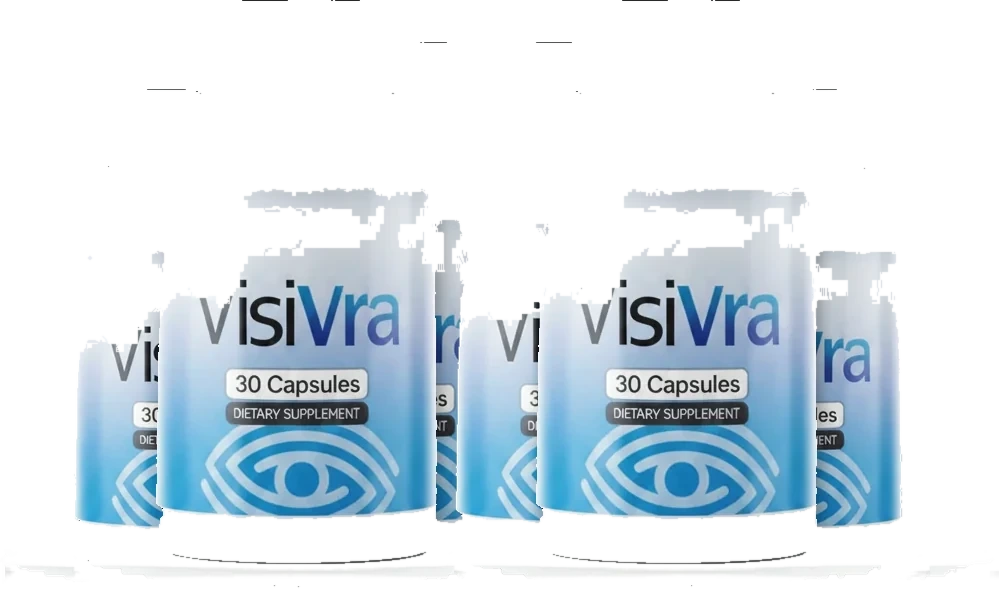
Visivra publishes its ingredient list, and like every product it should be judged on the Supplement Facts panel rather than the sales page. Read the panel, then decide.
Get OfferFree lutein or lutein esters: what a milligram actually means
This is the label distinction almost nobody covers, and it changes the meaning of a number rather than the number itself. It is also one of the main reasons two products can declare wildly different amounts of the same carotenoid, which we unpack in why eye supplement doses vary so much between products.
Most supplemental lutein comes from marigold (Tagetes erecta) flowers, where it occurs largely esterified — bonded to fatty acids. Manufacturers either saponify it to yield "free" lutein or leave it as lutein esters. This matters on a label because an ester's weight includes the fatty acid, so a milligram figure for lutein esters does not correspond to the same quantity of lutein molecules as the same figure for free lutein. Well-run panels resolve this by declaring "lutein esters, providing X mg free lutein". Poorly-run panels simply print a large number.
Which form absorbs better is genuinely contested, and the two best pieces of evidence disagree:
- The single-dose study. Bowen PE and colleagues, Journal of Nutrition 2002;132(12):3668-73 (PMID 12468605), gave 18 healthy adults a single dose of each formulation. The lutein diester formulation was 61.6% more bioavailable by area under the serum curve. This is the source of the "62% more bioavailable" claim on supplier blogs — a real, peer-reviewed number, but from a single dose in 18 people, and the authors' own conclusion was more modest: esterification "poses no impediment" to bioavailability, and how well the preparation dissolved mattered more than whether it was esterified.
- The chronic-dosing study. Olmedilla-Alonso B and colleagues, Nutrients 2024;16(10):1415 (PMID 38794653), ran a randomised crossover in 24 healthy adults, 6 mg of marigold lutein per day as free or ester form, two months per period. Serum lutein rose 2.4-fold by day 15 in both arms and held to day 60, with no difference between the free and ester forms at any timepoint. Contrast threshold responses were likewise no different.
The honest reading: over a single dose, formulation differences show up; over two months of daily dosing — which is how anybody actually takes a supplement — the two forms landed in the same place.
The vitamin E line, and why the form matters more than the IU
The same problem appears in a smaller way one row down. AREDS and AREDS2 both specified 400 IU of vitamin E, and IU is a potency unit, not a weight. Natural vitamin E (labelled d-alpha-tocopherol, or RRR-alpha-tocopherol) and synthetic vitamin E (dl-alpha-tocopherol, or all-rac-alpha-tocopherol) do not convert to milligrams at the same rate — the natural form counts for more per IU. So two panels can both read "400 IU" and contain visibly different milligram amounts of alpha-tocopherol.
US labels have largely moved to declaring vitamin E in milligrams, which makes this harder rather than easier for anyone comparing against a trial figure quoted in IU. The check is simple: find the form on the panel, not just the number. The NIH Office of Dietary Supplements publishes the current conversion factors for both forms — use that rather than a supplement blog.
Zinc and copper: a consistency check, not a recommendation
Zinc and copper compete for absorption in the gut, and sustained high zinc intake can reduce copper status — which is why both AREDS formulas paired 80 mg of zinc with 2 mg of copper as cupric oxide. The NIH Office of Dietary Supplements sets the tolerable upper intake level for zinc at 40 mg per day for adults from all sources combined, a limit derived from a measurable fall in erythrocyte copper-zinc superoxide dismutase activity — a copper-status marker — at higher intakes. So the trial formula deliberately used twice the adult upper limit, under medical supervision, in a population being followed for macular disease. That is a fact about a clinical trial, not a template for a shelf product. What sustained high-dose zinc actually does to a person over time is covered in eye supplement side effects.
What to do with it as a reader is narrow and specific:
- Check whether the zinc figure is elemental zinc or the weight of the salt. "Zinc (as zinc oxide) 25 mg" means 25 mg of zinc; "zinc gluconate 25 mg" means far less.
- Add up zinc across every supplement you take. Multivitamins, immune formulas and eye formulas stack.
- If a formula carries a high zinc figure and no copper, raise the difference with a pharmacist or doctor before you buy.
This is a checking rule, not advice on what to take. We are not recommending 80 mg of zinc, or any zinc amount. Dose decisions involving amounts near or above an upper intake level belong with a qualified clinician who knows your medications and history.
Upper limits, the %DV asterisk, and what "no Daily Value" means
Two numbers on a panel look like judgments and are not.
The asterisk. Under the same labelling rule, any ingredient with no established Daily Value carries a symbol — usually an asterisk or dagger — pointing to a footnote reading "Daily Value not established". Lutein, zeaxanthin and botanical extracts such as bilberry all fall in this category. It is not a warning and not an endorsement. It exists because there is no official reference intake for that ingredient, which is precisely why trial amounts are worth carrying in your head as a substitute yardstick.
The upper end for lutein. The most-cited formal figure is the European Food Safety Authority's acceptable daily intake, set in its 2010 re-evaluation of lutein as a food additive (E 161b): 1 mg per kilogram of body weight per day, roughly 70 mg a day for a 70 kg adult. It was derived from animal toxicity data with a 200-fold uncertainty factor and applies to lutein as an additive rather than as a supplement, so treat it as a reference point rather than a hard consumer ceiling. It still tells you something useful: typical supplemental amounts of 10 mg to 20 mg sit an order of magnitude below the formal limit, and a label promising an unusually large lutein figure is not thereby safer or better.
What a label cannot tell you
A panel is a declaration, not a measurement. It tells you what a company says is in the capsule. It does not verify identity, potency or purity — third-party testing and certificates of analysis are the only route to that, and no trial figure above will detect an overstated panel.
Matching a trial's numbers does not import the trial's results. AREDS2 tested one specific formula in people who already had intermediate macular changes, over years, with clinical monitoring. A product hitting the same milligrams is a formulation resemblance, not evidence about that product. No finished multi-ingredient supplement inherits the outcomes of a trial it was not in. And nothing on a panel predicts what happens to you: baseline diet, absorption, age and consistency all move the result, and none of them are printed anywhere.
Some things belong to a clinician, not a panel. Beta-carotene is the clearest example: it appeared at 15 mg in the original AREDS formula and was removed in AREDS2 partly over a lung-cancer signal in smokers. If you smoke or used to, that is a conversation with a doctor before a purchase, not a label check. And if you are weighing an ingredient claim rather than a number, our piece on bilberry and night vision shows how far a well-known ingredient story can outrun its trials.
For how the current Visivra formula lines up against these figures, see our full Visivra review.
Frequently asked questions
What should the lutein and zeaxanthin amounts be on an eye supplement label?
The reference figures are the amounts the AREDS2 trial used: 10 mg of lutein and 2 mg of zeaxanthin per day. Those are trial amounts, not a legal standard and not a recommendation, so a label can legitimately sit above or below them. The point of knowing the numbers is that you can compare, rather than guess, and a panel that will not tell you the milligrams at all cannot be compared to anything.
Is a proprietary blend on an eye supplement a red flag?
It is a visibility problem rather than proof of a bad product. Under the US labelling rules a proprietary blend has to show one total weight and list its ingredients in descending order of predominance by weight, but it does not have to show the amount of each one. In a 500 mg blend listing eight ingredients, the first ingredient could be 493 mg and the last one 1 mg, and the label would be entirely legal either way. If the milligrams are hidden, you cannot check them against anything.
Are lutein esters better absorbed than free lutein?
The evidence points both ways and the honest answer is that it is unsettled. A single-dose study of 18 people published in the Journal of Nutrition in 2002 found the diester formulation was 61.6 percent more bioavailable by area under the curve. A two-month randomised crossover in 24 adults published in Nutrients in 2024 gave 6 mg a day as free or ester lutein and found no difference in serum lutein at any timepoint, and no difference in contrast threshold either. Day-to-day dosing looks more like the second study than the first.
Why is there copper in an eye supplement with zinc?
High zinc intakes compete with copper for absorption, so the AREDS formulas included 2 mg of copper as cupric oxide alongside the 80 mg of zinc. On a label this is a consistency check rather than a recommendation: if a panel carries a high zinc figure and no copper at all, that is a difference from the trial formula worth asking a pharmacist or doctor about.
What does the asterisk in the percent Daily Value column mean?
It means no Daily Value has been established for that ingredient. Lutein, zeaxanthin and botanical extracts such as bilberry have no Daily Value, so they carry a symbol pointing to a footnote reading Daily Value not established. The asterisk is not a quality signal in either direction. It tells you there is no official reference amount, which is exactly why the trial figures are useful as a yardstick.
Medical note: this article explains how to read a label and what published trials contained. It is general information, not medical advice, and it does not claim any product diagnoses, treats, cures or prevents any condition. Speak to an eye-care professional or pharmacist before starting a supplement, particularly if you smoke, have smoked, take medication or already take zinc from another product.
Scientific references
- Age-Related Eye Disease Study 2 Research Group. Lutein + zeaxanthin and omega-3 fatty acids for age-related macular degeneration: the AREDS2 randomized clinical trial. JAMA 2013;309(19):2005-15. PMID 23644932
- National Eye Institute — About AREDS and AREDS2 (formulation composition, including the 25 mg low-zinc arm)
- Olmedilla-Alonso B, Granado-Lorencio F, Castro-Feito J, et al. Bioavailability of lutein from marigold flowers (free vs. ester forms): a randomised cross-over study to assess serum response and visual contrast threshold in adults. Nutrients 2024;16(10):1415. PMID 38794653
- Bowen PE, Herbst-Espinosa SM, Hussain EA, Stacewicz-Sapuntzakis M. Esterification does not impair lutein bioavailability in humans. J Nutr 2002;132(12):3668-73. PMID 12468605
- eCFR — 21 CFR 101.36, Nutrition labeling of dietary supplements (proprietary blends; "Daily Value not established")
- NIH Office of Dietary Supplements — Zinc fact sheet for health professionals (40 mg/day adult tolerable upper intake level)
- EFSA Panel on Food Additives and Nutrient Sources. Scientific opinion on the re-evaluation of lutein (E 161b) as a food additive. EFSA Journal 2010;8(7):1678. ADI 1 mg/kg bw/day
- NIH Office of Dietary Supplements — Vitamin E fact sheet (IU-to-milligram conversion for natural and synthetic alpha-tocopherol)
- US FDA — Dietary Supplement Labeling Guide
Now put the checklist to work
Six numbers, one phrase, and the ordering inside any blend. Take the list to whichever panel you are considering.
Get Offer